
- First Name
- Kevin
- Joined
- Mar 16, 2023
- Threads
- 55
- Messages
- 2,493
- Reaction score
- 3,712
- Location
- Gainesville
- Vehicle(s)
- 2023 Ford Bronco Sport Outer Banks Area51
Just be safe, and investigate thoroughly.
Sponsored
Last edited:
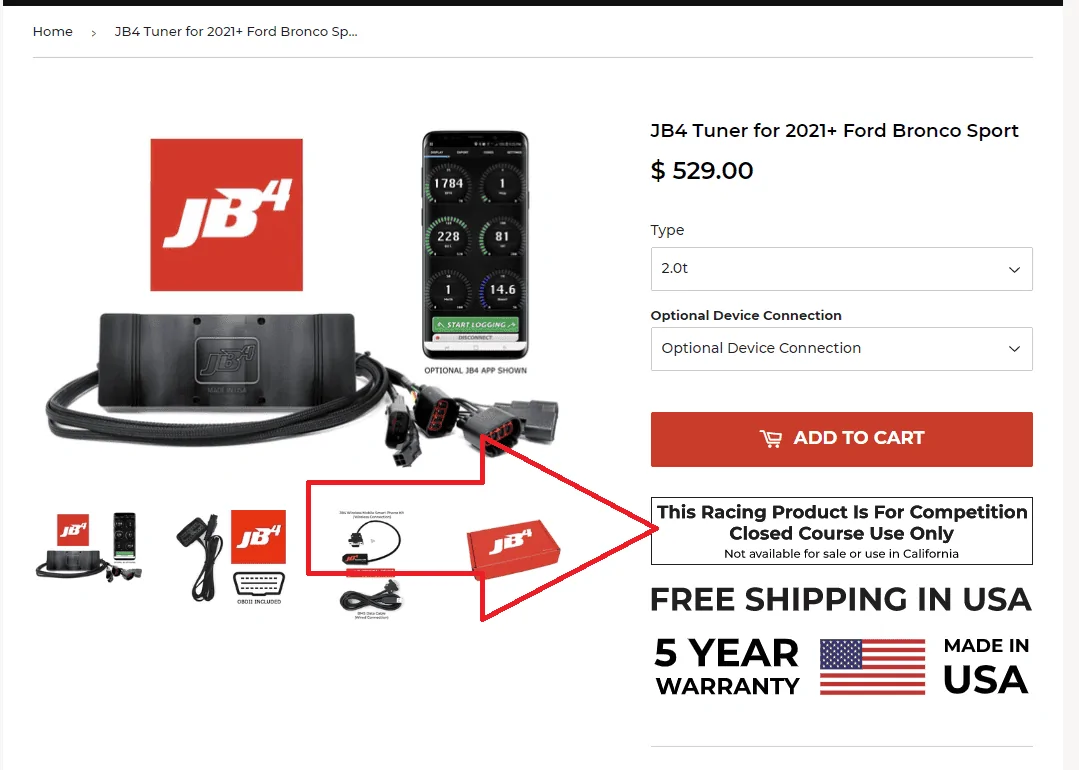
bought the Ford Tune for my MY22 Ranger and agree with your commentsJB4, is well known in the tuning industry so I wouldnt be worried about them standing behind their product/$529 isnt all that bad a price, I paid $700 for the Ford Performance Tuner for my full size Bronco and it made a big difference in the smoothness of the transmission (automatic shifting) and overall driveability with an approximate 10 to 15hp gain
If an when my BS Heritage Limited ever arrives I will be looking to squeeze out a few more HP out of the 2.0
Saw this over at the challenger forum I'm on. I think this owner will have a case against Dodge, as thehttps://www.autocare.org/government-relations/current-issues/Magnuson-Moss-Warranty-Act will protect a consumer against this type of action. In the link, it states "a manufacturer can only deny warranty coverage if it can demonstrate that a non-original equipment part or related service caused a defect to occur in the original product".
It has changed since I first read about this from the Challenger forum. First, it was denied due to removed mufflers. In reading it now (update#2), the PCM was tampered with. I agree with cprcubed statement bolded above...he will loose, even if he removed the tune at anytime prior to the engine failure. This is why I'd personally steer clear of a tune unless the factory warranty has expired, as you would not make a claim for warranty work then.I'm willing to bet that the legal team's fees to fight that in court will be more than the $36k engine. Also, if they have proof that the ECU had a unauthorized program on it, he'll lose. Cheers!
This is technically true, but I'm with @cprcubed on this one. Additionally, manufacturers face the risk of steep fines for violations of the Magnuson-Moss act, so I'm fairly confident when one denies a warranty claim for a stated reason it will have the proof it needs to defend itself should a customer wish to mount a court challenge.If update#2 is correct, then the Magnuson-Moss-Warranty-Act may not apply, as most tunes change the timing, rev limiter, and air/fuel mixture above the factory recommended limits. At best, maybe Dodge will offer a reduced price offer. They (Dodge) will still have to prove the modification caused the failure though.


This is what most people fail to do and just focus on the peak numbers. Torque increase is more useful for the daily grind.* Look at the before/after hp & torque curves. A large hp increase is not very useful if it is just a sharp peak at the top end of the rpm range. A broad increase, from just off idle to red line, is best.
Yup. And this is why I don't find software mods for EcoBoost engines worth the risk. The EcoBoost platform was designed from the start to provide greater torque at lower RPM to improve everyday driveability. Sure, you can get more low-end torque by mucking with the software, but high torque demand at low RPM is one of the primary contributors to low-speed preignition (LSPI). I just don't find the gains offered by a tune to be worth eroding the safety margins Ford's engineers built in to the OEM software to protect against LSPI.This is what most people fail to do and just focus on the peak numbers. Torque increase is more useful for the daily grind.
I think most tunes are relatively safe and in my experience most engine failure is a result of the owner playing with the tube (if they are able to) I know in the srt world you would get a diablo and I’ve seen some people tinker with the can tune when they have no clue what the tune is doing.The OEM powertrain control module incorporates limits on power output based on sensor readings to protect the engine from self destructing. These "tuners" work by intercepting those signals so the PCM receives false readings. The goal is to relax or eliminate the programmed safety limits so the engine can generate more power than Ford has deemed safe.
Some people have good luck with tuners, running them for years with no issues. Others experience catastrophic engine failure. There are two major problems with these devices: 1) there's generally no warning to let the driver know they operating close to or beyond a limit whose exceedance can result in catastrophic engine failure, and 2) if Ford discovers you installed one of these devices your warranty will not cover repairs. I know some will say you can always remove the device before making a warranty claim, and that's certainly true. It's also fraudulent, and downright scummy. Why should Ford pay for damage you caused?
I urge anyone considering one of these devices to think twice. If you have a need for more power you should probably just get a different vehicle.