
Top Tier Fuel

Mark S.

Badlands
Well-Known Member
First Name
Mark
Joined
Oct 30, 2021
Threads
119
Messages
6,733
Reaction score
13,150
Location
St. Jacob, IL
Vehicle(s)
2021 Badlands | 2020 Escape
It's really a GDI thing more than anything. This is ony my 3rd GDI engine. Before that, I was an 87-cheapest-gas-you-can-find guy.
It's not GDI that's the determining factor, it's whether the engine control system is programmed to take advantage of higher octane fuel. For example, the gas, direct-injection engine used as the base engine for the Dodge Challenger is a normally aspirated 3.6 liter V6 rated at 305 horsepower and 270 lb.-ft. of torque. The owner's manual specifies regular (87 octane) fuel, with no mention of premium. Given this is the kind of sports car where engine power is paramount, if it were possible to get more performance out of the engine using premium you can be sure the Owner's manual would mention it.
Sponsored


gatornek

Badlands
Well-Known Member
Joined
May 5, 2023
Threads
41
Messages
779
Reaction score
921
Location
Miami
Vehicle(s)
2023 Bronco Sport; 2016 Mustang 2.3
It's not GDI that's the determining factor, it's whether the engine control system is programmed to take advantage of higher octane fuel. For example, the gas, direct-injection engine used as the base engine for the Dodge Challenger is a normally aspirated 3.6 liter engine V6 rated at 305 horsepower and 270 lb.-ft. of torque. The owner's manual specifies regular (87 octane) fuel, with no mention of premium. Given this is the kind of sports car where engine power is paramount, if it were possible to get more performance out of the engine using premium you can be sure the Owner's manual would mention it.
Fair enough. I guess I've seen that type of tune more common in GDI. In all 3 of my GDI engines, they were documented sensitive to octane.
 

TNFurb

Outer Banks
Well-Known Member
Joined
Sep 15, 2023
Threads
3
Messages
145
Reaction score
254
Location
Nashville
Vehicle(s)
2023 Bronco Sport
I try to get Top Tier whenever possible. That’s why I go to Costco instead of Sam’s Club for gas. Sam’s is not top tier.
 

BourbonRunner

Heritage
Well-Known Member
First Name
Steve
Joined
Jul 8, 2023
Threads
9
Messages
292
Reaction score
531
Location
Baltimore Area
Vehicle(s)
Bronco Sport
It's not GDI that's the determining factor, it's whether the engine control system is programmed to take advantage of higher octane fuel. For example, the gas, direct-injection engine used as the base engine for the Dodge Challenger is a normally aspirated 3.6 liter V6 rated at 305 horsepower and 270 lb.-ft. of torque. The owner's manual specifies regular (87 octane) fuel, with no mention of premium. Given this is the kind of sports car where engine power is paramount, if it were possible to get more performance out of the engine using premium you can be sure the Owner's manual would mention it.

You're right about GDI not being a factor. All depends on the design. The BMW M54 is not GDI. Yet it demands a sacrifice of higher octane (and cash) to keep the demons at bay.

That being said, the Pentastar was put in the Challenger for better CAFE numbers and rental fleets, not performance. Its okay, but the Hemi is a totally different beast and a lot more fun.

Now, had it been a slant six instead of a V6... different story.
 

Bucko

Outer Banks
Well-Known Member
First Name
Kevin
Joined
Mar 16, 2023
Threads
55
Messages
2,494
Reaction score
3,706
Location
Gainesville
Vehicle(s)
2023 Ford Bronco Sport Outer Banks Area51
Presenters had favorable comments on Shell specifically.
I used to use Shell in all my vehicles due to their higher content of added Techron.

Now I just buy it at my local parts store when its on special, then pour it into the tank; usually once every 3rd or 4th tank fill up.

My 67 Camaro gets ethanol free gas to help with carb gum up because that car does not get driven daily (or weekly) at times.


CoastieN70

Badlands
Member
First Name
Lee
Joined
Feb 23, 2024
Threads
0
Messages
20
Reaction score
40
Location
Travelers Rest, South Carolina
Vehicle(s)
2024 Bronco Sport
91 octane and 93 octane are virtually the same.
93 octane is available at lower elevations, as you head towards the higher elevation states 93 octane becomes 91 octane. Air density makes the difference.
 

BravoAlpha

Badlands
Well-Known Member
Joined
Jan 21, 2022
Threads
2
Messages
379
Reaction score
726
Location
Oklahoma
Vehicle(s)
Bronco Sport Expedition MAX Silverado Z71
there‘s a few lengthy threads on this. I’d encourage a search.

what you’ll find is a very mixed bag of beliefs and results. I’ll abstain from piling on but I will say that as long as you are pumping fuel from a well-known,high traffic, reputable shop then I expect that you’ll be OK. top tier is a pay to play
 

rms34208

Badlands
Well-Known Member
First Name
Robert
Joined
Jul 20, 2020
Threads
5
Messages
89
Reaction score
104
Location
Florida
Vehicle(s)
Ford Escape 2013 SEL
I was watching a Porsche Workshop on YouTube last night and presenters were stressing the importance of using top tier fuel for engine health. I had never heard of top tier fuels. Service stations that use top tier fuel is supposed to contain additives that minimize carbon buildup in the engine. I have always purchased my gas from discounters such as Wawa, 7-11, Sheetz, and Liberty and none of those were on the top tier list, however I noticed that Marathon was. Marathon usually has fuel prices similar to the ones I use. I may be changing where I buy fuel. https://www.toptiergas.com/gasoline-brands/
Not so long ago I contacted Murphy Oil Company asking this same question about Top Tier Fuel. The answer with documentation was that retailers of Fuel Products pay for this designation. I have the 1.5
Dragon engine and have used several Fuels. The WaWa Ethanol free 87 octane is good and delivers approximately 30 mpg highway/ city,
Costco 93 Octane 26/27 Highway /city, Shell 93 Octane 31 to 33 highway/ city .
I live in a congested city in The Tampa Bay Florida area and as expected those of you in the hilly or mountainous regions will probably see reduced MPG,s. Shell has performed best for me but it is higher cost. I am hoping that using better grade fuel will reduce the carbon buildup on valves that is common on direct injection engines as well as increase performance of the Turbo.
Has anyone installed a Catch Can and if so has this increase performance ,reduced carbon in oil ?
Thanks.
 

Escape2Bronco

Badlands
Well-Known Member
First Name
Steve
Joined
Oct 9, 2021
Threads
5
Messages
3,384
Reaction score
4,853
Location
Wisconsin
Vehicle(s)
2013 Lexus ES, 2022 Bronco Sport, 2023 Bronco Heritage 2 dr
Exactly right, Mark, and very well stated.

My 2004 BMW with the MB54 straight six requires 91 octane (like most naturally aspirated BMWs of yore) but 91 is as rare as hen's teeth, ergo it gets 93 all the time. And if I'm near a Sunoco with high test, I'll occasionally run a tank of that through, even if it isn't track day.
It all about the compression and timing. A higher compression vehicle needs the higher octane to keep it from pre-detonation. As Marks says above, most newer cars can sense it and adjust the timing to keep the car from knocking. In the old days, we would just pop the hood and twist the distributer if Hi-test couldn't be found.
 

Mark S.

Badlands
Well-Known Member
First Name
Mark
Joined
Oct 30, 2021
Threads
119
Messages
6,733
Reaction score
13,150
Location
St. Jacob, IL
Vehicle(s)
2021 Badlands | 2020 Escape
It all about the compression and timing. A higher compression vehicle needs the higher octane to keep it from pre-detonation.
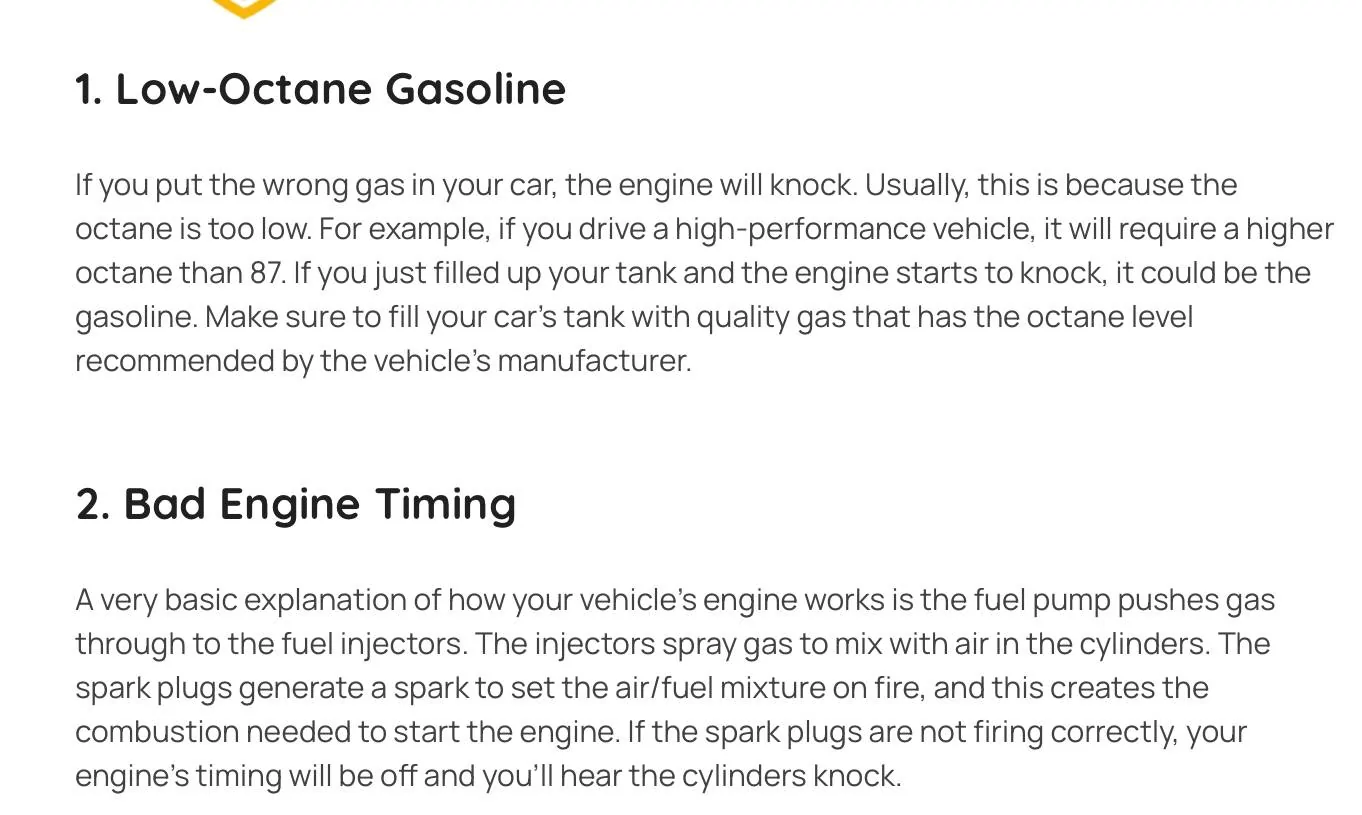
I think you meant detonation, or knocking. This is the uncontrolled ignition of the fuel/air mixture after the spark plug fires. Pre-ignition is not generally a result of low octane fuel. It occurs when an ignition source other than the spark plug causes the mixture to ignite BEFORE the spark plug fires. Turn down the sound on your device (unless you like overly dramatic music) and watch the video below. It does a great job of illustrating the difference between these two phenomena.


Escape2Bronco

Badlands
Well-Known Member
First Name
Steve
Joined
Oct 9, 2021
Threads
5
Messages
3,384
Reaction score
4,853
Location
Wisconsin
Vehicle(s)
2013 Lexus ES, 2022 Bronco Sport, 2023 Bronco Heritage 2 dr
I think you meant detonation, or knocking. This is the uncontrolled ignition of the fuel/air mixture after the spark plug fires. Pre-ignition is not generally a result of low octane fuel. It occurs when an ignition source other than the spark plug causes the mixture to ignite BEFORE the spark plug fires. Turn down the sound on your device (unless you like overly dramatic music) and watch the video below. It does a great job of illustrating the difference between these two phenomena.

Exactly, the lower octane fuel will detonate before the spark plug fires in a higher compression engine. This is what we used to call pre detonation.
 

Mark S.

Badlands
Well-Known Member
First Name
Mark
Joined
Oct 30, 2021
Threads
119
Messages
6,733
Reaction score
13,150
Location
St. Jacob, IL
Vehicle(s)
2021 Badlands | 2020 Escape
Exactly, the lower octane fuel will detonate before the spark plug fires in a higher compression engine. This is what we used to call pre detonation.
Negative, Ghost Rider. Pre-ignition can occur even if you are using the correct octane. It's caused by a heat source within the cylinder--glowing carbon deposits, burning oil, left-over fuel not expelled during the exhaust stroke, a too-hot spark plug, etc.--causing the fuel/air mixture to ignite BEFORE the spark fires. That's why it's called pre-ignition; ignition occurs before it's supposed to.

Detonation occurs AFTER the spark fires. The rapid increase in cylinder pressure after the spark ignites the mixture can generate enough heat to cause the mixture in another area of the cylinder to ignite spontaneously. The tell-tale "ping" or knock you hear is two (or more) flame fronts colliding inside the cylinder. A higher octane fuel requires more heat to ignite, therefore offers some measure of protection from detonation.

This Wikipedia article describes detonation in detail.

This Wikipedia article describes pre-ignition.

There is a note in each article not to confuse one with the other. These are two distinct phenomena.
 

Escape2Bronco

Badlands
Well-Known Member
First Name
Steve
Joined
Oct 9, 2021
Threads
5
Messages
3,384
Reaction score
4,853
Location
Wisconsin
Vehicle(s)
2013 Lexus ES, 2022 Bronco Sport, 2023 Bronco Heritage 2 dr
Negative, Ghost Rider. Pre-ignition can occur even if you are using the correct octane. It's caused by a heat source within the cylinder--glowing carbon deposits, burning oil, left-over fuel not expelled during the exhaust stroke, a too-hot spark plug, etc.--causing the fuel/air mixture to ignite BEFORE the spark fires. That's why it's called pre-ignition; ignition occurs before it's supposed to.

Detonation occurs AFTER the spark fires. The rapid increase in cylinder pressure after the spark ignites the mixture can generate enough heat to cause the mixture in another area of the cylinder to ignite spontaneously. The tell-tale "ping" or knock you hear is two (or more) flame fronts colliding inside the cylinder. A higher octane fuel requires more heat to ignite, therefore offers some measure of protection from detonation.

This Wikipedia article describes detonation in detail.

This Wikipedia article describes pre-ignition.

There is a note in each article not to confuse one with the other. These are two distinct phenomena.
Ok, I’ll say uncle. My point was low octane gas in a higher compression engine can cause it to knock. Two ways to fix it. Use higher octane gas or in the old days, adjust the timing.

I was thinking I’d buzz the tower anyways just to see if you spilled your coffee! :cool:

Ford Bronco Sport Top Tier Fuel IMG_1094
 
Last edited:

AndyMac204

Base
Well-Known Member
First Name
Andy
Joined
Jun 27, 2021
Threads
13
Messages
889
Reaction score
1,565
Location
Canada
Vehicle(s)
2021 Bronco Sport Base / 1988 Dodge Power Ram w150
always 91 or higher. 75000 km and runnin purrrty.


Top