
What MPG and Range can we expect on the Bronco Sport?

NMhunter

Badlands
Well-Known Member
First Name
Mike
Joined
Feb 8, 2022
Threads
2
Messages
743
Reaction score
1,054
Location
Albuquerque
Vehicle(s)
BS Badlands
My lifetime average is over 27 MPG. I do a 100 mile trip weekly where I drive 70 for 42 miles and the rest of the trip is between 30 and 50 mph. I usually get 32 to 34 mpg. Stop and go traffic kills my mileage, along with wind, roof rack, trailer, or off road driving. Off road, I average around 20 mpg.
Sponsored


 

Bucko

Outer Banks
Well-Known Member
First Name
Kevin
Joined
Mar 16, 2023
Threads
55
Messages
2,494
Reaction score
3,706
Location
Gainesville
Vehicle(s)
2023 Ford Bronco Sport Outer Banks Area51
My ""lifetime" average with the 2023 OB and 1.5 liter is 24.4 MPG.

I drive 90% city type traffic with lots of stop and go. the other 10% is when we visit our son (a two hour country drive). We see 27 MPG on that trip.
 

Stircrazy

Outer Banks
Well-Known Member
First Name
Steve
Joined
Aug 25, 2024
Threads
9
Messages
382
Reaction score
483
Location
BC, Canada
Vehicle(s)
2023 Bronco sport
What is your average mileage for life of the vehicle.
that is irelivent unless you are the original owner and drive the same route all the time with the same driving style.

I bought my bronco as a used demo (still sold as new, just with a discount for the milage) so as it was a demo how did everyone who put the 29000km on it drive it? when I jumped in it for a test drive it was at 9.1L/100km, myself driving in town I get in the low 7's. I don't treat every light like it is a drag strip christmas tree, and I accelerate smothly up to speed.

for my trips to work I have goten it down to 6.7L/100km, but I live in the mountians and leave an elivation of 347ish Meters and 100km later I am at about 1200M. round trip I am averaging 6.7-6.8 depending if I have to pass anyone, and 1/2 of that is at a speed of 120-125kph and the other half is at 110kph and that average is over 4000km now.

the rental bronco I had in ontario averaged 6.3L/100km over the 3000km of driving I did there all over the provence, so that includes limited city driving also

it would seam that if your not getting under the advertised highway milage, your driving like its a race car haha.
 

Bucko

Outer Banks
Well-Known Member
First Name
Kevin
Joined
Mar 16, 2023
Threads
55
Messages
2,494
Reaction score
3,706
Location
Gainesville
Vehicle(s)
2023 Ford Bronco Sport Outer Banks Area51
If you want to reset the average MPG values on a used Bronco (or any used vehicle for that matter), unplug the battery for a few minutes, then reattach. This will set the values back to zero.
 
OP
OP
NickAtNight

NickAtNight

Heritage
Well-Known Member
First Name
Nicholas James
Joined
Oct 8, 2024
Threads
4
Messages
86
Reaction score
50
Location
LaPlace La
Vehicle(s)
Bronco Sport Heritage 2023
I just made my first long trip…. WOAH

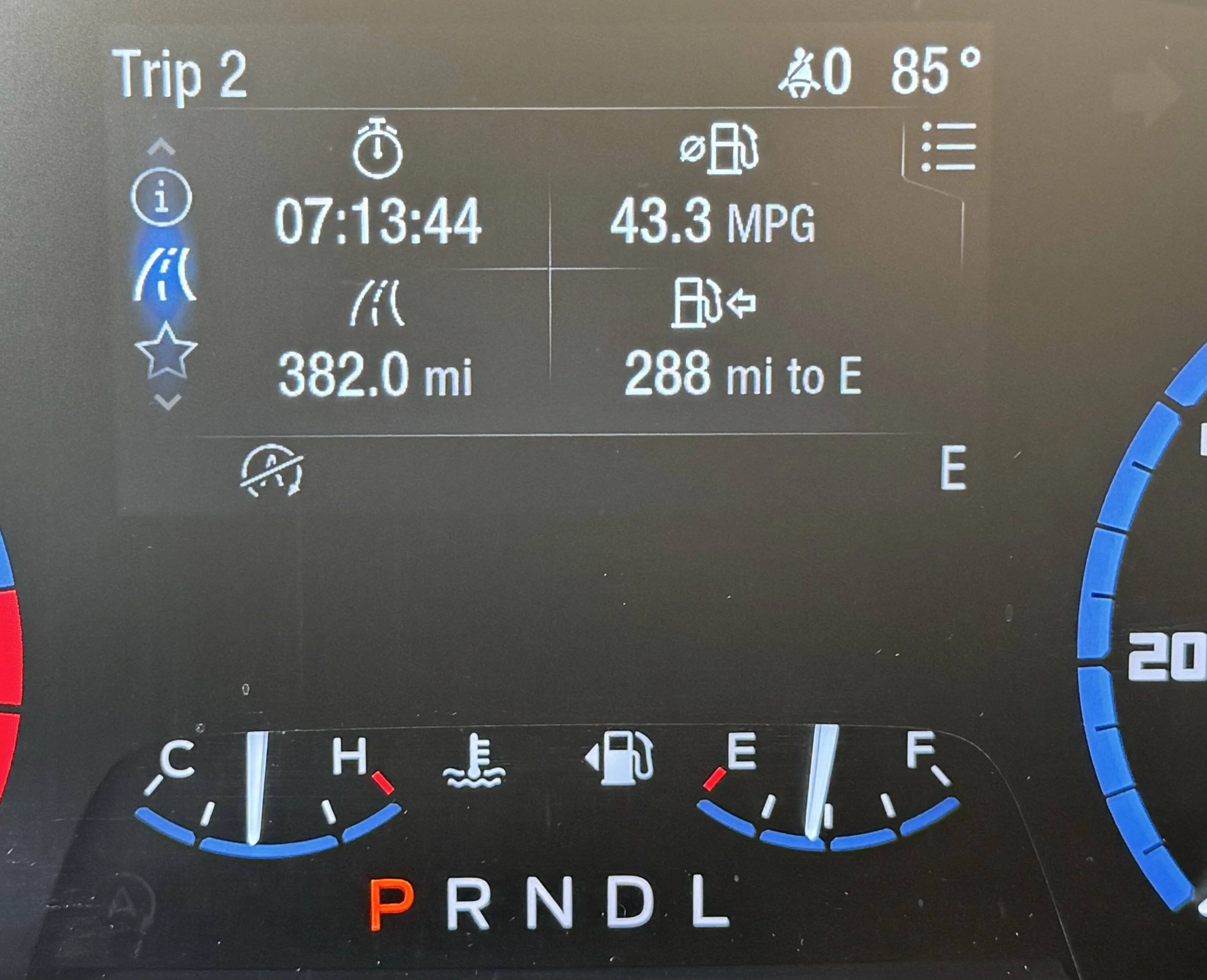
43.3 MPG for 372 miles in 7:13.5 hours !!!

Ford Bronco Sport What MPG and Range can we expect on the Bronco Sport? IMG_5949
Not bad. Normal driving mileage is about 26-27 MPG.
But long trips are cruising speed have been ~43 MPG.

Initial: 27.3 MPG 132.7 miles 6.841 Hours. 19.4 MPH.
First trip: 43.3 MPG 382.0 miles 7.229 hours. 52.8 MPH.
Vacation: 26.1 MPG 263.7 miles 12.544 hours. 21.0 MPH
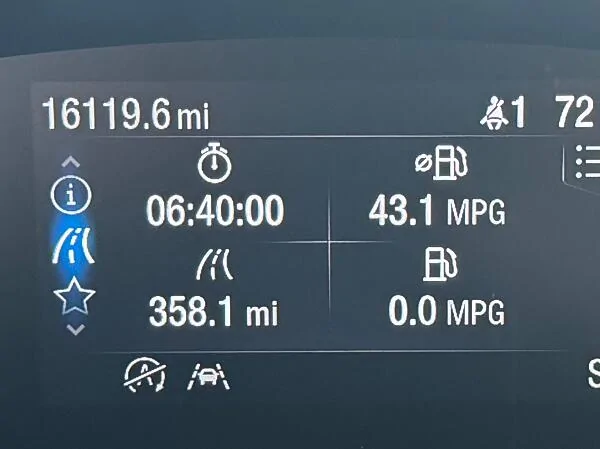
Return trip: 43.1 MPG 358.1 miles 6.667 hours. 53.7 MPH
Overall: 35.3 MPG 1,137.4 milrd 33.576 hours 33.4 MPH

Note: For that average, instant mileage rate must be higher.

1. A 10 mile cruising stretch at 55 MPH was ~51.7 MPG.
2. A 12 miles cruising stretch at 59 MPH was ~47.1 MPG.
3. A 17 mile cruising stretch at 55 MPH was ~49.0 MPG.

On the return trip, I figured out how to put on the instant MPG reading. The eyeballed average value for the instant values are in that range.
Ford Bronco Sport What MPG and Range can we expect on the Bronco Sport? IMG_6272


V8 Yankee

Outer Banks
Well-Known Member
First Name
Harold
Joined
Feb 6, 2022
Threads
18
Messages
359
Reaction score
574
Location
Miami
Vehicle(s)
21 Bronco Sport
My lifetime average for my 2021 1.5L engine is a consistent 34.0 mpg. I’ve currently got 47,000 miles on the odometer and hand-calculate my fuel efficiency at every fill-up. After testing various fuel brands and grades, I’ve found that I get the best mileage using 93 octane fuel from Chevron or Costco. My daily commute is an 80-mile round trip with identical conditions—flat terrain, same driving style—and about 90% of that is freeway driving, maintaining a speed between 55 and 60 mph with cruise control on.

One important tip: adjust your ECU fuel bias based on your actual hand calculations. The factory settings can be off by as much as 20%, so don’t rely solely on the display’s reading. You’ll also need to break in the engine before seeing accurate MPG numbers. For me, things didn’t stabilize until I hit 3,000 miles.

I’ve made a few modifications, including a cold air intake (CAI), a custom exhaust, and I run full synthetic oil. I also use fuel injector cleaner with every oil change. On rare occasions, I’ve hit tank averages as high as 48 mpg, usually when the wind is in my favor. Best of luck, and enjoy the ride!
 
Last edited:
OP
OP
NickAtNight

NickAtNight

Heritage
Well-Known Member
First Name
Nicholas James
Joined
Oct 8, 2024
Threads
4
Messages
86
Reaction score
50
Location
LaPlace La
Vehicle(s)
Bronco Sport Heritage 2023
My lifetime average for my 2021 1.5L engine is a consistent 34.0 mpg. I’ve currently got 47,000 miles on the odometer and hand-calculate my fuel efficiency at every fill-up.
That is extremely impressive.
 
OP
OP
NickAtNight

NickAtNight

Heritage
Well-Known Member
First Name
Nicholas James
Joined
Oct 8, 2024
Threads
4
Messages
86
Reaction score
50
Location
LaPlace La
Vehicle(s)
Bronco Sport Heritage 2023
After testing various fuel brands and grades, I’ve found that I get the best mileage using 93 octane fuel from Chevron or Costco.
I am using E10 (10% alcohol) regular (87 Octane) currently.

I am curious as to what your testing has found for the effect of Octane rating. For my Accord, I thought I observed an improvement in MPG. Online research (AAA, et. al.) are claiming the Octane rating has no effect on MPG.

They do recommend 'top tier' fuels - ones with top quality fuel injector cleaner added. (Hmm, that program seems to be only in effect in Colorado and Kansas area.
 

V8 Yankee

Outer Banks
Well-Known Member
First Name
Harold
Joined
Feb 6, 2022
Threads
18
Messages
359
Reaction score
574
Location
Miami
Vehicle(s)
21 Bronco Sport
I even tried ethanol free 90, (rec fuel) as they call it Florida. It cost about .50 cents more than 93 octane. I have to say it ran smoother but the cost wasn't worth it. With 93 octane I get about 1 to 1.5 better mpg. The extra cost doesn't offset the gain from 87 but it runs stronger, especially in Sport Mode. I ran 87 for about a year and it did just fine. If I was towing or hauling people and cargo I would definitely pay extra for fuel. The Dragons are lightweight engines, you really notice it when you get behind the wheel of a similar SUV/CUV with 4 or 6 cylinder. Just no comparison with the bigger engines. In reality it does everything I need and getting 34 mpg is awesome as its basically a commuter for me. I'm glad I bought it but if I was towing I would get up to to the 6000 plus towing capacity.
 

Bill G

Badlands
Well-Known Member
First Name
Bill
Joined
Aug 16, 2021
Threads
6
Messages
727
Reaction score
1,550
Location
San Gabriel Valley, CA
Vehicle(s)
21 Bronco Sport Badlands, 66 Tiger
JMO — one reason you might get better mpg with 93 over 87 octane is that car runs “stronger” with higher octane, so you push less on the throttle to get the same “feel” of performance in any given circumstance. At least that’s how it seems to me when I’m behind the wheel.


Mark S.

Badlands
Well-Known Member
First Name
Mark
Joined
Oct 30, 2021
Threads
119
Messages
6,733
Reaction score
13,154
Location
St. Jacob, IL
Vehicle(s)
2021 Badlands | 2020 Escape
JMO — one reason you might get better mpg with 93 over 87 octane is that car runs “stronger” with higher octane, so you push less on the throttle to get the same “feel” of performance in any given circumstance. At least that’s how it seems to me when I’m behind the wheel.
This is a physics problem. The car has a given mass, and the engine must produce a given amount of power to accelerate it at a given rate, and a given amount of power requires a given amount of fuel. The computer may change throttle response when using premium fuel, which means you get more power with less pedal travel. That doesn't change the physics: accelerating the vehicle's mass at a give rate still requires the same amount of power--and same amount of fuel. TANSTAAFL.

I've yet to hear a satisfactory explanation for improvement in fuel economy when using premium fuel. Accelerating a mass and keeping it moving requires a given amount of energy. The amount of energy in fuel is measured by British Thermal Units (BTUs). Regular and premium contain the same amount of BTUs. The benefits of premium over regular for Ford's EcoBoost series of engines are improved resistance to detonation--especially on hot days when the engine is heavily taxed--and a boost in maximum power. In other words, when burning premium, Ford's EcoBoost engines are capable of converting more of the heat energy produced by burning gasoline into useful power, mainly owing to changes in fuel mixture and ignition timing. The caveat is these changes occur only under certain conditions, specifically the conditions that would result in detonation when burning regular. Those conditions occur when the engine is producing the most heat, and that happens under the highest power demand. When no mixture or timing changes are necessary to prevent detonation (i.e. low power demand, such as cruising down the highway) the engine operates exactly the same whether burning regular or premium.

If you are towing a trailer in the mountains on a hot day you will almost certainly get better performance from your engine burning premium. You might even see some improvement in fuel economy. That's because your engine will be operating near its thermal limits. The computer will use more fuel under those conditions when burning regular to aid in thermal regulation. I can't think of any other highway driving conditions under which you would see improvements in fuel economy.

I've hand-measured fuel economy since day one with my car, including switching between regular and premium several times. When switching, I always burn at least three tanks to average out all the variables. I've never seen an increase in fuel economy using premium. You can see my data and methodology in this thread.
 
Last edited:

V8 Yankee

Outer Banks
Well-Known Member
First Name
Harold
Joined
Feb 6, 2022
Threads
18
Messages
359
Reaction score
574
Location
Miami
Vehicle(s)
21 Bronco Sport
Your technical analysis is highly commendable. I appreciate the empirical approach, with data grounded in measurable parameters. It is incontrovertible that data collection must occur under controlled conditions to ensure maximum accuracy. This includes variables such as wind direction, ambient temperature, humidity levels, vehicle weight, terrain characteristics, speed, and additional factors like roof cargo or towing, as well as driving behavior (e.g., conservative versus aggressive driving). When these factors are meticulously controlled during fuel efficiency tests, the outcomes should remain consistent, with only marginal deviations, irrespective of the fuel's octane rating.
However, when these parameters shift to uncontrolled environments—essentially real-world driving conditions—the variance in results becomes more pronounced. In my specific case, I can only regulate weight, speed, and driving style, while factors such as weather and road conditions are governed by external influences, such as natural environmental fluctuations or by the Florida Department of Transportation. I typically follow the same route, covering an 80-mile round trip three times a week, along with an additional 10-20 miles of city driving each week. I typically fuel up once a week as well.
It’s these variables that significantly influence fuel economy (mpg), and the type of fuel used plays a crucial role in how efficiently a 1.5L engine delivers power under real-world conditions. After covering 47,000 miles with manual calculations, consistently driving the same route, I can confidently assert that octane level does impact performance. While the difference may be slight, it is nonetheless measurable when comparing different fuel types. Additionally, fuel quality can be further affected by additives present in premium fuel formulations, such as those used by Top Tier suppliers. Lower-cost fuels often have inferior additive compositions, which can also influence performance.
While we may have overanalyzed the topic slightly, I personally find the subject fascinating and continually experiment with new techniques to optimize fuel efficiency without compromising on-road dynamics, such as maintaining reasonable speeds to avoid triggering road rage incidents.
 
OP
OP
NickAtNight

NickAtNight

Heritage
Well-Known Member
First Name
Nicholas James
Joined
Oct 8, 2024
Threads
4
Messages
86
Reaction score
50
Location
LaPlace La
Vehicle(s)
Bronco Sport Heritage 2023
I am a recently retired Chemical Engineer. The BTU value of the fuels are NOT the same!

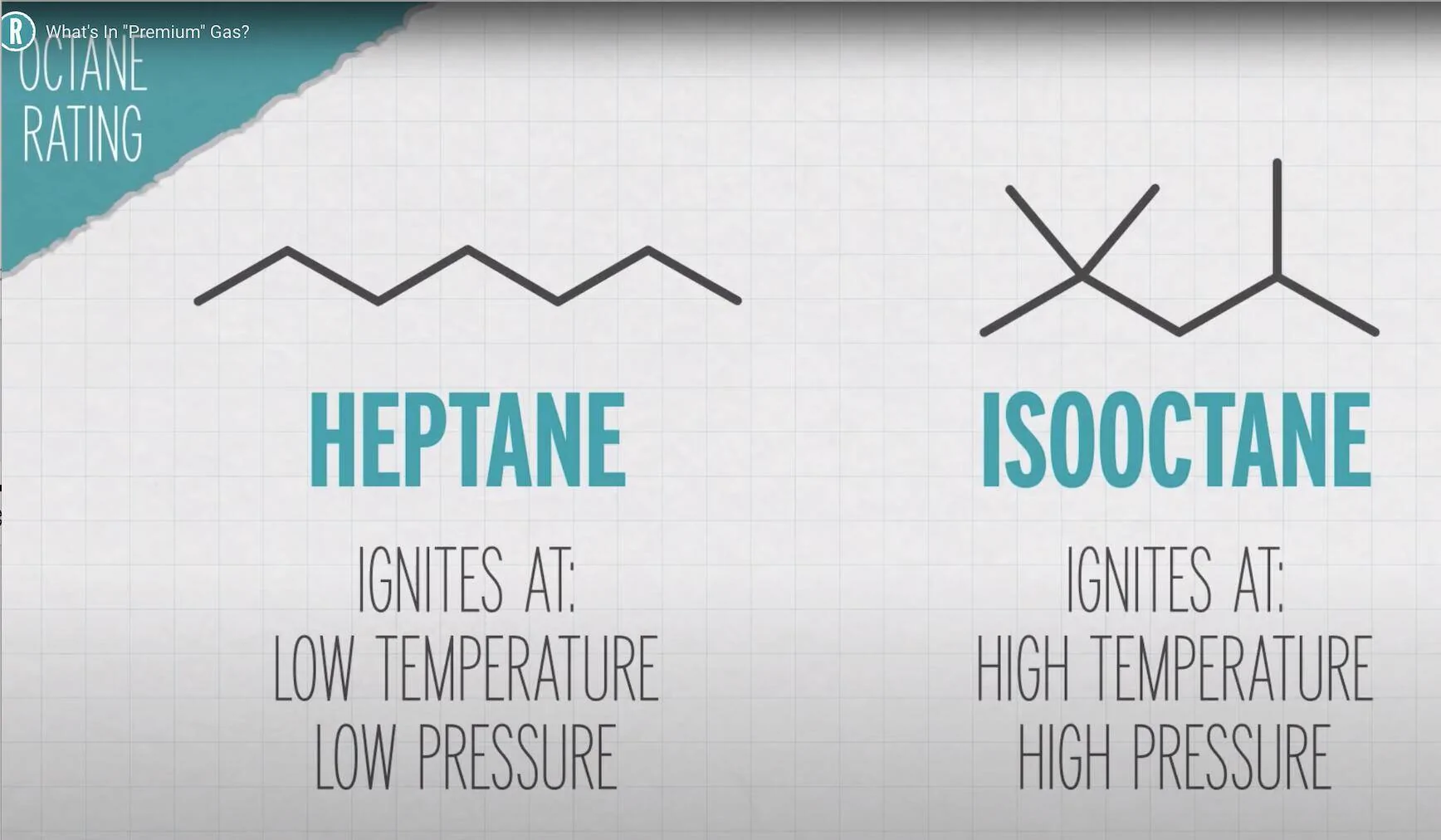
In this American Chemical Society video, we have to get 7:32 minutes into the 8:43 minute video before she FINALLY admits that the higher Octane fuels have a wee (teeny tiny) bit more energy... but she then claims that this higher bit of energy is not worth the extra cost. She ends with '...promise, your not helping. Just lighting money on fire. Just pouring gasoline on money and lighting it on fire'. (SIGH.? So much for a 'scientific' explanation !)
Ford Bronco Sport What MPG and Range can we expect on the Bronco Sport? Screen Shot 2024-10-21 at 2.16.42 PM


The proof is in the pudding. There should be some simple comparisons of the different gasolines with their stated BTU value. But danged if I can find them.

So let's go back to basics.

The boilers at work ran on Methane (CH4) with a touch of Ethane (C2H6) and Propane (C3H8) added to increase the BTU value. The supplier would add enough of the other two chemicals to maintain the heating content of the fuel over 1,010 BUT/scf.

Note the increase in heating value for the fuels as the number of carbons increases.

The same is true of the higher carbon fuels in gasoline. If we reduce it to just two isomers (n-heptane (0%) and iso-octane (100%) then the isooctane has 13.3% more BTU value than the n-heptane.

So based on my ignorant calculation, I would estimate that the 91 Octane fuel would have 0.5% more BTU value per scf. And the 91 Octane fuel would have 0.7% more BTU value per scf/

GasNet Heating Value (BTU/scf)Number of Carbons
Methane9111
Ethane1,6312
Propane2,3533
---------
n-hexane4,4046
n-heptane5,1007
n-octane5,7968
---------
Isooctane5,7798
My ignorant calculation
87 Octane5,691100%
91 Octane5,718100.5%
93 Otane5,731100.7%

Ford Bronco Sport What MPG and Range can we expect on the Bronco Sport? Screen Shot 2024-10-21 at 2.19.44 PM


I've yet to hear a satisfactory explanation for improvement in fuel economy when using premium fuel. …The amount of energy in fuel is measured by British Thermal Units (BTUs). Regular and premium contain the same amount of BTUs.
?
 
OP
OP
NickAtNight

NickAtNight

Heritage
Well-Known Member
First Name
Nicholas James
Joined
Oct 8, 2024
Threads
4
Messages
86
Reaction score
50
Location
LaPlace La
Vehicle(s)
Bronco Sport Heritage 2023
Thank you.

I think the key difference would be the 'additives' - the stuff that keeps the carbon deposit buildup over time down. Unfortunately, the manufacturers do not give us the information on what and how much they add.

...After covering 47,000 miles with manual calculations, consistently driving the same route, I can confidently assert that octane level does impact performance. While the difference may be slight, it is nonetheless measurable when comparing different fuel types. Additionally, fuel quality can be further affected by additives present in premium fuel formulations, such as those used by Top Tier suppliers. Lower-cost fuels often have inferior additive compositions, which can also influence performance.
 
OP
OP
NickAtNight

NickAtNight

Heritage
Well-Known Member
First Name
Nicholas James
Joined
Oct 8, 2024
Threads
4
Messages
86
Reaction score
50
Location
LaPlace La
Vehicle(s)
Bronco Sport Heritage 2023
Your technical analysis is highly commendable. I appreciate the empirical approach, with data grounded in measurable parameters.
I know next to nothing about car oils.

Many years ago at work, I convinced the plant to change from using mineral oil to a synthetic oil (alkyl-benzene). The mineral oil was degrading in under three months on our compressors. After switching to the synthetic oil, we got reasonable oil life.

Before management agreed to the switch, they asked me to check to see what our sister plant in Japan was using... When I asked, it turned out they had long ago switched to the same synthetic. That sealed the deal for management.

While doing the research, I found this great machinery lubrication site. They had this cool 'business card' check to check the status of our car's oil.
Ford Bronco Sport What MPG and Range can we expect on the Bronco Sport? backup_200207_Editor-Hand


Notice the cause of his premature oil failure was due to water buildup in his oil. He was not driving his car enough - so the moisture levels built up in the oil. He was only making short drives, and those drives were not sufficient to heat up the oil to drive out the moisture.

Mr. Fitch provided some great advice on practical oil analysis. That gave us a quick indication of where the oil life was before the official lab analysis results were obtained.

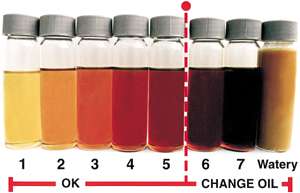
He also had this cool visual oil check for the oil. As the oil is operated, it gets visually darker. So in a standard size sample container, we could use this visual chart to compare our oil condition.

Color test for oil.
Ford Bronco Sport What MPG and Range can we expect on the Bronco Sport? Backup_199811_graphics_color1


Top