

What did you do TO your Bronco Sport today?

Meanderthal

Badlands
Well-Known Member
First Name
Eric
Joined
Mar 19, 2022
Threads
10
Messages
2,164
Reaction score
3,155
Location
Belleville, IL
Vehicle(s)
'08 BMW R1200 GS Adv, '23 Norden Expedition
Hmmm. Not to be argumentative, but I believe that is the very definition of a passive device. Meaning is doesn't work without the exhaust gas coming out of the engine (er go passive).

Probably a "you say potatoes..." argument.
Potatoe, like Delm said, it won’t do anything without exhaust. I interpreted your post as basically saying a turbo does nothing. I don’t know what you thought pushed the air to the turbo. I just had a discussion with Delm about how a turbo creates a relatively consistent vacuum in the intake.

It does take some power from the engine to run the turbo. There is more back pressure in the system which means that during the exhaust stroke, the engine has to push harder to get the exhaust out of the engine. The turbo more than makes up for the power required. To date it is the most efficient of the turbo/pro charger/super charger grouping of power adders. The only thing I can think of right now that is more efficient is nitrous. As efficient as the turbo is, it does still take some energy to make it work.

So, is that passive? I guess it is up to you.
Sponsored

 

Meanderthal

Badlands
Well-Known Member
First Name
Eric
Joined
Mar 19, 2022
Threads
10
Messages
2,164
Reaction score
3,155
Location
Belleville, IL
Vehicle(s)
'08 BMW R1200 GS Adv, '23 Norden Expedition
But it does depend on engine power. It's power that's otherwise wasted out the tailpipe, but it's power nonetheless. It's the same kind of energy that powers a turbine engine. It was genius to realize the energy wasted out the exhaust system could be used to power a compressor.


Which is the very definition of a non-passive device.
A turbine engine is only slightly related to what is happening in a turbo. The turbine engine does the compression, ignition, expansion, and exhaust. The exhaust of a turbine engine is somewhat similar to a turbo.

The turbo isn’t using heat to make it work. I think that a lot of people believe that, but it isn’t really the truth. It uses hot exhaust gas but it isn’t harvesting that heat to create kinetic energy. There are some things people do to try and keep heat in the exhaust, the reason for that is that if it loses temp it will also lose pressure. You want as much of the exhaust pressure to remain as you can get, so you want to keep that gas as hot as possible.
 

Idahobro

Outer Banks
Well-Known Member
First Name
David
Joined
Jan 7, 2023
Threads
5
Messages
87
Reaction score
113
Location
It's Private
Vehicle(s)
Mache GT, F350
Potatoe, like Delm said, it won’t do anything without exhaust. I interpreted your post as basically saying a turbo does nothing. I don’t know what you thought pushed the air to the turbo. I just had a discussion with Delm about how a turbo creates a relatively consistent vacuum in the intake.

It does take some power from the engine to run the turbo. There is more back pressure in the system which means that during the exhaust stroke, the engine has to push harder to get the exhaust out of the engine. The turbo more than makes up for the power required. To date it is the most efficient of the turbo/pro charger/super charger grouping of power adders. The only thing I can think of right now that is more efficient is nitrous. As efficient as the turbo is, it does still take some energy to make it work.

So, is that passive? I guess it is up to you.
LOL. Yes, I know a turbo runs off the exhaust.

Yes, I know it takes more power from the engine to spool the turbo, and yes, I know there is a net gain from a turbo. I have a 6.7 PSD.

Yes, that is passive.

"
FUNCTION OF LOAD, NOT ENGINE SPEED

The energy that turns a turbocharger’s turbine wheel comes from the hot exhaust gas leaving an engine’s cylinder. The turbocharger is passive since it responds to a much lesser extent to engine crankshaft speed than exhaust temperature. That is why you will hear the turbo spin up when the engine is loaded, even though there may be little to no increase in engine speed.

As the load on the engine increases, so do the exhaust temperature and its velocity. When the exhaust leaves the port of the cylinder head, the inert gas experiences isentropic expansion. This means without temperature change.

The hot and expanding gases are forced into the turbine housing and act on the turbine wheel in the same manner the flow of a river would have had on an old grist mill. The compressor wheel then feeds air to the intake manifold under pressure. The result is an increase in VE, power, and reduced emissions."
 

Meanderthal

Badlands
Well-Known Member
First Name
Eric
Joined
Mar 19, 2022
Threads
10
Messages
2,164
Reaction score
3,155
Location
Belleville, IL
Vehicle(s)
'08 BMW R1200 GS Adv, '23 Norden Expedition
LOL. Yes, I know a turbo runs off the exhaust.

Yes, I know it takes more power from the engine to spool the turbo, and yes, I know there is a net gain from a turbo. I have a 6.7 PSD.

Yes, that is passive.

"
FUNCTION OF LOAD, NOT ENGINE SPEED

The energy that turns a turbocharger’s turbine wheel comes from the hot exhaust gas leaving an engine’s cylinder. The turbocharger is passive since it responds to a much lesser extent to engine crankshaft speed than exhaust temperature. That is why you will hear the turbo spin up when the engine is loaded, even though there may be little to no increase in engine speed.

As the load on the engine increases, so do the exhaust temperature and its velocity. When the exhaust leaves the port of the cylinder head, the inert gas experiences isentropic expansion. This means without temperature change.

The hot and expanding gases are forced into the turbine housing and act on the turbine wheel in the same manner the flow of a river would have had on an old grist mill. The compressor wheel then feeds air to the intake manifold under pressure. The result is an increase in VE, power, and reduced emissions."
Okay, if you want to call it passive then you are free to do so. Potato!

Have you come to the conclusion that the turbo can pull air through the intake? That was truly the crux (at least in my mind) to your post.


Mark S.

Badlands
Well-Known Member
First Name
Mark
Joined
Oct 30, 2021
Threads
119
Messages
6,731
Reaction score
13,153
Location
St. Jacob, IL
Vehicle(s)
2021 Badlands | 2020 Escape
“Components incapable of controlling current by means of another electrical signal are called passive devices. Resistors, capacitors, inductors, transformers, and even diodes are all considered passive devices”
Also from a description of "passive" electronic components:

Generally, passive components are not able to increase the power of a signal nor are they able to amplify it.
Using that definition, a turbocharger most definitely increases an engine's power.

We can argue about whether it's a passive device or not all day and I doubt we will change each other's minds. My primary dispute with your previous post was your claim that a turbocharger doesn't depend on engine power for operation. I don't believe that to be the case, and I don't think you do either given your statement that "at the end of the day, [the turbocharger] won't do much without a running engine."
 
Last edited:

Mark S.

Badlands
Well-Known Member
First Name
Mark
Joined
Oct 30, 2021
Threads
119
Messages
6,731
Reaction score
13,153
Location
St. Jacob, IL
Vehicle(s)
2021 Badlands | 2020 Escape
A turbine engine is only slightly related to what is happening in a turbo. The turbine engine does the compression, ignition, expansion, and exhaust. The exhaust of a turbine engine is somewhat similar to a turbo.
Turbine engines operate by harnessing the flow of hot, expanding exhaust gases to spin a turbine wheel. That wheel is connected via a common shaft to a large compressor which forces pressurized air into the combustion chamber. It's exactly the same principle as a turbocharger writ large.

How do you square these two comments?

The turbo isn’t using heat to make it work.
vs

...the reason for that is that if it loses temp it will also lose pressure. You want as much of the exhaust pressure to remain as you can get, so you want to keep that gas as hot as possible.
So is it using heat or not?

Physics tells us there’s a direct, linear relationship between absolute temperature and pressure, therefore the pressure inside the exhaust manifold is inextricably linked to heat. Exhaust gas flow results because there's relatively high heat (pressure) on the engine side and relatively low heat (pressure) on the exit side. In other words, the more heat in the exhaust gas the higher the flow.

Here's an interesting video explaining the physics behind turbo blankets based on a study by UT Austin in 2016. The upshot is there are performance gains to be had by containing exhaust heat in the turbocharger. A turbo blanket can also prevent heat-related damage to other nearby engine components. IMHO, for your ordinary, average daily driver, the benefits do not justify the increased wear a turbocharger will experience by using a blanket, but they explain why most race teams running turbocharged engines use a blanket on the turbocharger.


delm

Badlands
Well-Known Member
First Name
David
Joined
Mar 1, 2022
Threads
10
Messages
268
Reaction score
540
Location
Atlanta
Vehicle(s)
'22 BS Badlands; '23 BS Badlands; BMW X3, X7
Also from a description of "passive" electronic components:


Using that definition, a turbocharger most definitely increases an engine's power.

We can argue about whether it's a passive device or not all day and I doubt we will change each other's minds. My primary dispute with your previous post was your claim that a turbocharger doesn't depend on engine power for operation. I don't believe that to be the case, and I don't think you do either given your statement that "at the end of the day, [the turbocharger] won't do much without a running engine."
Turbos most definitely increase an engine’s power. But that is not the same thing as increasing electric current.

Correct - I could have been more clear and tried to clarify when I stated that it operates indirectly from the engine. The main point being, it is not operating off a belt, like a supercharger, which is not passive.


IdahoDirtFarmer

Big Bend
Well-Known Member
First Name
Shane
Joined
Sep 25, 2022
Threads
2
Messages
280
Reaction score
382
Location
Caldwell, ID
Vehicle(s)
Ram 1500 ordered '23 sport
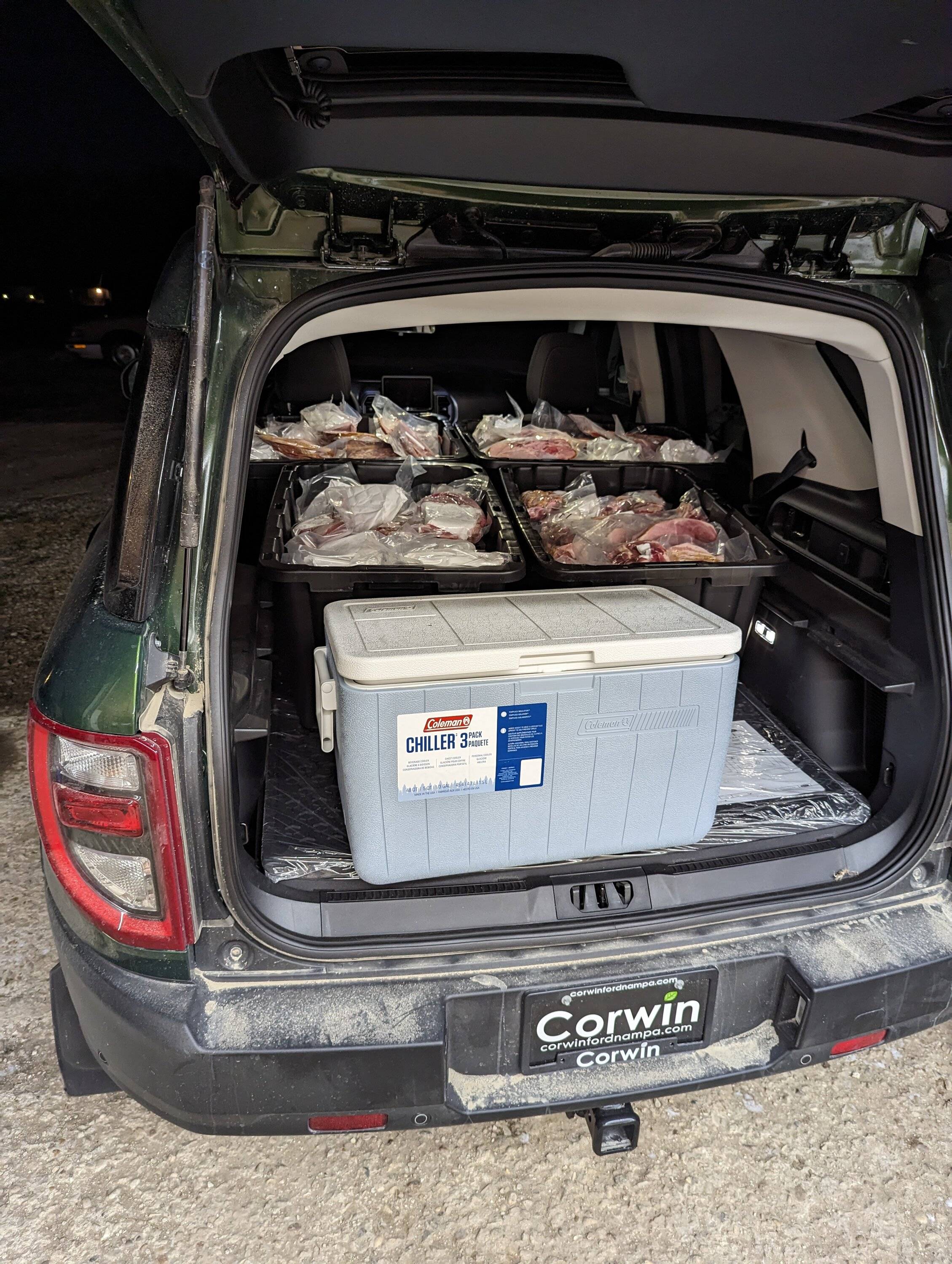
Not really something I did "to" my Bronco, but if anyone is wondering you can fit 3 whole hogs in the back of a Bronco. Forgot to take a pic. before I pulled two milk crates out though. 600 lbs. of pork fits just fine.

Ford Bronco Sport What did you do TO your Bronco Sport today? PXL_20230225_021627312
 

Mark S.

Badlands
Well-Known Member
First Name
Mark
Joined
Oct 30, 2021
Threads
119
Messages
6,731
Reaction score
13,153
Location
St. Jacob, IL
Vehicle(s)
2021 Badlands | 2020 Escape
Not really something I did "to" my Bronco, but if anyone is wondering you can fit 3 whole BUTCHERED hogs in the back of a Bronco.
One slight correction. Unless you have a photo of three UNBUTCHERED hogs in your Bronco. Now THAT'S something I'd like to see!
 

IdahoDirtFarmer

Big Bend
Well-Known Member
First Name
Shane
Joined
Sep 25, 2022
Threads
2
Messages
280
Reaction score
382
Location
Caldwell, ID
Vehicle(s)
Ram 1500 ordered '23 sport
One slight correction. Unless you have a photo of three UNBUTCHERED hogs in your Bronco. Now THAT'S something I'd like to see!
If they could jump high enough to get them loaded I might give it a whirl. Hard enough getting those assholes to step up into the stock trailer for their final road trip.
 

Meanderthal

Badlands
Well-Known Member
First Name
Eric
Joined
Mar 19, 2022
Threads
10
Messages
2,164
Reaction score
3,155
Location
Belleville, IL
Vehicle(s)
'08 BMW R1200 GS Adv, '23 Norden Expedition
Turbine engines operate by harnessing the flow of hot, expanding exhaust gases to spin a turbine wheel. That wheel is connected via a common shaft to a large compressor which forces pressurized air into the combustion chamber. It's exactly the same principle as a turbocharger writ large.

How do you square these two comments?


vs


So is it using heat or not?

Physics tells us there’s a direct, linear relationship between absolute temperature and pressure, therefore the pressure inside the exhaust manifold is inextricably linked to heat. Exhaust gas flow results because there's relatively high heat (pressure) on the engine side and relatively low heat (pressure) on the exit side. In other words, the more heat in the exhaust gas the higher the flow.

Here's an interesting video explaining the physics behind turbo blankets based on a study by UT Austin in 2016. The upshot is there are performance gains to be had by containing exhaust heat in the turbocharger. A turbo blanket can also prevent heat-related damage to other nearby engine components. IMHO, for your ordinary, average daily driver, the benefits do not justify the increased wear a turbocharger will experience by using a blanket, but they explain why most race teams running turbocharged engines use a blanket on the turbocharger.

Warning, lot’s of thinking out loud here:

Is it using heat? Not to any real extent. Let’s try a thought experiment. Let’s supply pressurized air at room temperature to the “exhaust” side of the turbo. There is a change in pressure as the air passes through the turbo, which does lead to a change in temperature as well. Does that mean the turbo used the heat, or did it use the pressure? The turbo would work basically the same no matter the temperature of the air used to drive it.

When you compress a gas, the temperature will rise. The reason for that is you have taken the same amount of energy (heat) and put it in a smaller space. When you let that gas expand again, the temperature will go down but you still have the same amount of energy (heat). No heat was used in the process. There are some losses in the real world but let’s not make this too complicated.

There is a hot gas involved here but the turbo isn’t using that heat for anything. The turbo works off the change in pressure. My point about losing heat and the use of turbo blankets and other devices is that you don’t want to lose heat energy to the outside environment because that would lower the pressure. Essentially, if the turbo does start to “use” heat it then looses pressure, which we don’t want. We want as much of the energy as possible to go into the pressure drop. There is going to be some energy loss due to changing temperature but we want to minimize that because that loss reduces the useful energy we have to turn the turbo.

The leap here is that a change in temperature is not the same as a change in heat for this system. The temperature increases when the pressure increases but the heat is the same.

On the intake side of the engine, we do try to lose heat. That is in the intercooler, where we want to shed heat energy. We would prefer to keep all the heat in the exhaust gas until it gets through the turbo. That is why the turbo is as close as possible to the exhaust side of the head. Probably also the reason we don’t mind having a long passage for the intake side. We lose some due to friction but we are also shedding heat in all that piping along with the intercooler.

Maybe this is another potato/potatoe debate?


Top