
Sponsored

The first thing to do on BS

Schuelady

Outer Banks
Well-Known Member
First Name
Tami
Joined
Aug 16, 2024
Threads
7
Messages
363
Reaction score
505
Location
Nebraska
Vehicle(s)
Plan on getting 2025 Bronco Sport
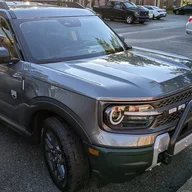
So I have decided the very first exterior upgrade for a new BS is 3M clear protection for the front of the hood the leading edge of the front fenders and the painted portion of trim around the front grill. From my experience and from what I have seen by paint thickness testers the paint is extremely thin compared to most other vehicles. The rock chips appearing on my BS has me searching out a local shop to apply such protection. Many vehicles come with some sort of clear vinyl on the front of the hood and other wear prone areas. Too bad with such thin paint Ford didnt take the initiative.
I did actually have something very similar added to my 2025 Outer Banks back when I first picked it up. They recommended a place and took it there to have it done. So far it has been working great!
Sponsored


jkernitzki

Badlands
Well-Known Member
First Name
John
Joined
Dec 13, 2024
Threads
59
Messages
1,449
Reaction score
3,724
Location
Arizona
Vehicle(s)
2025 Badlands Sasquatch
There is a chance that we will be injured or even killed every time we hit the road, but that does not stop us from travelling.
And yet we have auto and/or medical insurance coverages just for that eventuality... ;)
 

sajohnson

Badlands
Well-Known Member
First Name
Sherman
Joined
Dec 1, 2021
Threads
31
Messages
1,903
Reaction score
2,037
Location
MIDDLETOWN, MD
Vehicle(s)
'22 Badlands ordered 12/17/2021 - Arrived 3/25/22
And yet we have auto and/or medical insurance coverages just for that eventuality... ;)
Good point. To clarify:

We should all be self-insured to the extent possible. For most of us that means we still must purchase homeowners; health; auto; and possibly life and/or disability insurance -- because the potential loss is so great.

Also, insurance or not, most folks are averse to dying in a fiery car wreck -- yet they realize the chances of that happening are very, very slim, so they are not overly concerned about it.

Same with major repairs -- bad news, but highly unlikely, at least with most vehicles, over the period covered by the warranty.

Generally speaking, there are three issues:

1) The likelihood of a given event happening.
2) The severity/cost of that event.
3) Whether that cost can be paid by the individual.

It's smart to think ahead and buy insurance if appropriate (when no insurance = bankruptcy) but also to recognize that being self-insured is the best financial move, when possible.
 

PHRIOS

Badlands
Active Member
First Name
Paulo
Joined
Sep 5, 2025
Threads
2
Messages
32
Reaction score
56
Location
ARAXA/Minas Gerais/Brasil
Vehicle(s)
Ford Bronco Sport
Believe it or not, one thing I added shortly after buying the bike, and regret not adding sooner, is the shiftpower, which eliminates throttle delay. I practice plug and play and it doesn't affect the warranty. I highly recommend it.
 

jkernitzki

Badlands
Well-Known Member
First Name
John
Joined
Dec 13, 2024
Threads
59
Messages
1,449
Reaction score
3,724
Location
Arizona
Vehicle(s)
2025 Badlands Sasquatch
Good point. To clarify:

We should all be self-insured to the extent possible. For most of us that means we still must purchase homeowners; health; auto; and possibly life and/or disability insurance -- because the potential loss is so great.

Also, insurance or not, most folks are averse to dying in a fiery car wreck -- yet they realize the chances of that happening are very, very slim, so they are not overly concerned about it.

Same with major repairs -- bad news, but highly unlikely, at least with most vehicles, over the period covered by the warranty.

Generally speaking, there are three issues:

1) The likelihood of a given event happening.
2) The severity/cost of that event.
3) Whether that cost can be paid by the individual.

It's smart to think ahead and buy insurance if appropriate (when no insurance = bankruptcy) but also to recognize that being self-insured is the best financial move, when possible.
All good points, and I completely agree. I was just having a friendly go at you. :)

Insurance and warrantees are not investments, they're a bet based on one's willingness and ability to absorb risk. The most useful forms are liability and catastrophic loss coverages. After that, the value proposition drops dramatically.

My personal formula includes all those issues, but adds opportunity cost. The cost of the ESP (through Granger) is likely less than than one or two otherwise out-of-warranty repairs of major components, and far less than I could earn investing it over the ten-year period of coverage.

Also, the money spent the ESP isn't entirely a sunk cost, in that should I decide to part ways with the BS in, say, five years, it retains some residual value in a sale or trade as it's transferrable.

Could I go without the ESP (or most of my auto coverages)? Technically, yes. I could certainly replace the BS tomorrow out of pocket if there was no other option, but I'd just as soon pay a fraction of that to have someone else assume that degree of risk.


sajohnson

Badlands
Well-Known Member
First Name
Sherman
Joined
Dec 1, 2021
Threads
31
Messages
1,903
Reaction score
2,037
Location
MIDDLETOWN, MD
Vehicle(s)
'22 Badlands ordered 12/17/2021 - Arrived 3/25/22
All good points, and I completely agree. I was just having a friendly go at you. :)

Insurance and warrantees are not investments, they're a bet based on one's willingness and ability to absorb risk. The most useful forms are liability and catastrophic loss coverages. After that, the value proposition drops dramatically.

My personal formula includes all those issues, but adds opportunity cost. The cost of the ESP (through Granger) is likely less than than one or two otherwise out-of-warranty repairs of major components, and far less than I could earn investing it over the ten-year period of coverage.

Also, the money spent the ESP isn't entirely a sunk cost, in that should I decide to part ways with the BS in, say, five years, it retains some residual value in a sale or trade as it's transferrable.

Could I go without the ESP (or most of my auto coverages)? Technically, yes. I could certainly replace the BS tomorrow out of pocket if there was no other option, but I'd just as soon pay a fraction of that to have someone else assume that degree of risk.
Much of this comes down to a person's outlook, or, put another way <Clint Eastwood> "Do ya feel lucky punk?" :cool:

Pessimists read stories of catastrophic failure and think, "With my luck, that's gonna happen to me!" without any stats/data to back up that assumption.

Optimists may think nothing bad will ever happen to them.

The pessimistic group will be inclined to buy a warranty, no matter how rational the arguments against it are.

The optimists may not even bother getting health insurance.

I was nodding my head while reading the first part of your post, until I read this:

"The cost of the ESP (through Granger) is likely less than than one or two otherwise out-of-warranty repairs of major components, and far less than I could earn investing it over the ten-year period of coverage."

1) It's absolutely true that even one major repair can cost more than the warranty. The question is, how likely is that to happen? We know it cannot be very often or the underwriter would go bankrupt. The vast majority of owners will not have any covered repairs, or the repairs they do have would have cost less than the warranty (plus exclusions, deductibles, and lost interest on money spent).

2) Granted, the interest earnings on the money (if not spent on the warranty) may not be huge but it is an additional cost, like exclusions and deductibles. Using this calculator: https://www.investor.gov/financial-tools-calculators/calculators/compound-interest-calculator

Over 10 years, $2,000 grows to roughly $4,000 to $6,000+ total, dep on interest rate (I entered 10% with a +/- 2% range).

Finally, you said:

"I could certainly replace the BS tomorrow out of pocket if there was no other option, but I'd just as soon pay a fraction of that to have someone else assume that degree of risk."

Nothing wrong with that. Everyone has to make those choices for themselves. At the end of the day, the cost of an ESP is not huge, but financially they are almost always a bad deal.

I don't always follow my own advice. For example, we just got our homeowner's insurance bill. It increased by $1,000 for no reason. We live in a shack (an old log cabin) that we could replace out of pocket if we had to. After seeing the bill I briefly considered being self-insured for homeowners, but settled on raising our deductible to 5% of covered value, which brought our bill down to below where it was previously. Of course there's a chance that we could have a large claim and end up having to pay that 5% (D'OH!) but there is a much greater chance that won't happen. If we have one large claim in the next 15-20 years we'll break even. If we have none (likely) and are still alive, then we'll be ahead.
 

jkernitzki

Badlands
Well-Known Member
First Name
John
Joined
Dec 13, 2024
Threads
59
Messages
1,449
Reaction score
3,724
Location
Arizona
Vehicle(s)
2025 Badlands Sasquatch
2) Granted, the interest earnings on the money (if not spent on the warranty) may not be huge but it is an additional cost, like exclusions and deductibles. Using this calculator: https://www.investor.gov/financial-tools-calculators/calculators/compound-interest-calculator

Over 10 years, $2,000 grows to roughly $4,000 to $6,000+ total, dep on interest rate (I entered 10% with a +/- 2% range).
Find me a guaranteed 10% return and I'll kiss you full on the lips! :p

S&P over the last 10 years (adjusted for inflation) is in the 10-12% range, but that's an outlier. It's more like 6-7% historically. Other investment avenues are markedly worse.

Inflation also hits the cost of repairs as well. Parts & labor have gone up 43% since 2019. I see it as paying now for a far cheaper price with money that is worth more today than it will be in future years.

Just another way to look at it. But it all reinforces your point of everyone having to take a hard look at their own situation and comfort level and acting accordingly, and be willing to live with the result.
 

dockiwi57

Badlands
Well-Known Member
Joined
Aug 14, 2025
Threads
4
Messages
82
Reaction score
169
Location
USA
Vehicle(s)
26 BSBL
Fun conversation, risk. Appreciate all the well thought out points. Dealers love extended warranties. A couple of things that always catch me up is 1) thinking about paying for something, every month, that I won't be able to use until 3-5 years down the road and 2), wondering how many people maintain a liquid 4-6 month emergency fund for unforeseen bumps in the road. My folks used to say: "pay yourself first." Wasn't any easier in 1936 when they started out than it is now.
 

sajohnson

Badlands
Well-Known Member
First Name
Sherman
Joined
Dec 1, 2021
Threads
31
Messages
1,903
Reaction score
2,037
Location
MIDDLETOWN, MD
Vehicle(s)
'22 Badlands ordered 12/17/2021 - Arrived 3/25/22
Find me a guaranteed 10% return and I'll kiss you full on the lips! :p

S&P over the last 10 years (adjusted for inflation) is in the 10-12% range, but that's an outlier. It's more like 6-7% historically. Other investment avenues are markedly worse.

Inflation also hits the cost of repairs as well. Parts & labor have gone up 43% since 2019. I see it as paying now for a far cheaper price with money that is worth more today than it will be in future years.

Just another way to look at it. But it all reinforces your point of everyone having to take a hard look at their own situation and comfort level and acting accordingly, and be willing to live with the result.
From Fidelity:

"The historical average annual return of the S&P 500 is roughly 10% to 11% since its inception in 1957, assuming dividends are reinvested."

From Experian:

"Historically, the average stock market return is around 10% annually..."

Even assuming 8%, the $2,000 grows to $4,000+ over 10 years.

Regardless of the exact number, there is an opportunity cost to purchasing an ESP (or anything else). In this case it is not insignificant.

Good point about inflation. Of course that's only an issue if repairs are required. Also, the underwriter takes inflation into account when pricing the ESP.

People often mention that:

1) Vehicles these days are complicated
2) Labor can be $200/hour
3) Parts are crazy expensive
4) There are specific known issues

That's all true, but we know nothing that the underwriter is not aware of. The only owners who can possibly even the odds somewhat are those that frequently tow, in the mountains, in summer, at or close to the GVWR. That, along with significant (but not abusive) off-road use. Since the cost of the warranties is based on typical use, a person pushing the allowable limits is more likely to see the ESP pay off.

Aside from that, there is nothing the underwriter doesn't factor in. They are "the house" and they hold the cards. All insurance is a losing game. It must be, for the ins companies to stay in business. As a group, customers must pay in more than they get back. As a general rule, it's best (financially) to avoid insurance when possible.

Some folks want peace of mind, and that's fine, but they should know that the chance of a warranty "paying off" is slim.
 

JPtapt

Big Bend
Well-Known Member
Joined
Nov 4, 2025
Threads
4
Messages
73
Reaction score
146
Vehicle(s)
2025 Bronco Sport
From Fidelity:

"The historical average annual return of the S&P 500 is roughly 10% to 11% since its inception in 1957, assuming dividends are reinvested."

From Experian:

"Historically, the average stock market return is around 10% annually..."

Even assuming 8%, the $2,000 grows to $4,000+ over 10 years.

Regardless of the exact number, there is an opportunity cost to purchasing an ESP (or anything else). In this case it is not insignificant.

Good point about inflation. Of course that's only an issue if repairs are required. Also, the underwriter takes inflation into account when pricing the ESP.

People often mention that:

1) Vehicles these days are complicated
2) Labor can be $200/hour
3) Parts are crazy expensive
4) There are specific known issues

That's all true, but we know nothing that the underwriter is not aware of. The only owners who can possibly even the odds somewhat are those that frequently tow, in the mountains, in summer, at or close to the GVWR. That, along with significant (but not abusive) off-road use. Since the cost of the warranties is based on typical use, a person pushing the allowable limits is more likely to see the ESP pay off.

Aside from that, there is nothing the underwriter doesn't factor in. They are "the house" and they hold the cards. All insurance is a losing game. It must be, for the ins companies to stay in business. As a group, customers must pay in more than they get back. As a general rule, it's best (financially) to avoid insurance when possible.

Some folks want peace of mind, and that's fine, but they should know that the chance of a warranty "paying off" is slim.
I'm not looking for it to pay off. I just want peace of mind that my vehicle is pretty much handled for the next ten years. I'm in my 70s and was fortunate enough that I didn't need financing. If I had to do that, it would be a different matter. It was worth it to me in my particular circumstances.


RSH

Badlands
Well-Known Member
First Name
Robert
Joined
Mar 23, 2021
Threads
2
Messages
1,396
Reaction score
2,064
Location
California
Vehicle(s)
Bronco Sport
I don't see many of the latest vehicles being long term survivors with all the plastic parts they have these days.
Water pumps, intake manifolds, oil pans, emissions parts, plastic radiator end caps, valve covers, turbo charger plumbing,, touch screen controls for HVAC and entertainment all being in a harsh automotive environment and that's not counting major components like transmission or engine replacement.
With major component replacement cost being so high and if planning to keep a late model vehicle long term do you take your chances and hope for the best or buy an extended warranty as piece of mind or do you have the means to pay if something happens.

For example, the Ford powertrain warranty basically says that Ford only believes in their vehicle for 60k miles, after that you are on your own unless you want to pay for more coverage, at that point you and Ford are each placing a bet on what will happen, will the vehicle hold up over a certain time/mileage period or not.
 

Summers22

Outer Banks
Well-Known Member
First Name
Jon
Joined
Dec 5, 2025
Threads
5
Messages
98
Reaction score
164
Vehicle(s)
2001 Ford Ranger 2019 F250 Superduty 2023 Bronco Sport Outerbanks
For me, the fact of the matter is at 53 years old, would rather spend the $100 each repair that exceeds that. I paid $2650 to Flood Ford for an additional 60k and 5 years. I am at 40k currently. Do I have the tools and means for repairs? Yep, I just replaced all 4 balljoints, axle half shafts, tie rod ends and drag link end a couple months ago on my 19 F250 Superduty. Took me a full day, but saved a ton and hurt like hell for a couple days. Currently my 23 OB has a rattling muffler, P130D code, keeps going into limp mode and we all know how high the likelihood of the waterpump shooting craps is. Add 1 headlight or taillight and I'll be even. Its peace of mind and ease of repair at this point in my life.
Sponsored


Top