
What MPG and Range can we expect on the Bronco Sport?

B-Dog15

Big Bend
Well-Known Member
First Name
Brandon
Joined
Nov 13, 2023
Threads
10
Messages
307
Reaction score
647
Location
Covington, Ky
Vehicle(s)
Bronco Sport
Before anyone roasts me I am not claiming to be smart or knowledgeable on this topic at all because I promise you I am not… HOWEVER, since switching to 93, I have gotten almost an extra 40-50 miles per tank calculated both by hand and by the odometer. (Difference by a mile or two between them) Driving patterns are exactly the same with no changes coming from my end. (that I’m aware of that is)

Also with all the discounts Shell gives me the extra money spent is negligible. Also, after speaking with multiple Ford mechanics they all recommended using high octane for the sake of the life of engine.
Sponsored


 

Mark S.

Badlands
Well-Known Member
First Name
Mark
Joined
Oct 30, 2021
Threads
119
Messages
6,733
Reaction score
13,154
Location
St. Jacob, IL
Vehicle(s)
2021 Badlands | 2020 Escape
There should be some simple comparisons of the different gasolines with their stated BTU value. But danged if I can find them. So based on my ignorant calculation, I would estimate that the 91 Octane fuel would have 0.5% more BTU value per scf. And the 91 Octane fuel would have 0.7% more BTU value per scf/
The article I linked to is from MIT's School of Engineering. That seems like a pretty good source to me. Excerpt:

When combusted, premium (high-octane) gasoline and the less-expensive (and less-glamorous) regular, and all grades in between, provide the same amount of thermal energy, or heat, which an engine uses to generate the mechanical power that moves a vehicle.
we have to get 7:32 minutes into the 8:43 minute video before she FINALLY admits that the higher Octane fuels have a wee (teeny tiny) bit more energy...
Even if this is true (and I have no reason not to believe it) I've seen claims suggesting upwards of 5% better fuel economy using premium fuel. This cannot be explained by a <1% difference in BTU content.

Not sure what this means. Are you also sad that no satisfactory explanation exists to explain how premium fuel may increase fuel economy?

I have gotten almost an extra 40-50 miles per tank calculated both by hand and by the odometer.
What time of year did you switch? Two of the biggest factors affecting fuel economy are ambient temperature and summer/winter gas formulation. If you switched fuels when around the switch from winter to summer blend--which usually corresponds to significant changes in temperature--that could significantly skew your results. Excerpt from link:
Why Winter Fuel Economy is Lower
Cold weather affects vehicles in more ways than one might expect:
  • Engine and transmission friction increases in cold temperatures due to cold engine oil and other drive-line fluids.
  • It takes longer for an engine to reach its most fuel-efficient temperature. This affects shorter trips more, since a vehicle spends more of a short trip at less-than-optimal temperatures.
  • Heated seats, window defrosters, and heater fans use additional power.
  • Warming up a vehicle before starting a trip lowers fuel economy—idling gets 0 miles per gallon.
  • Colder air is denser, increasing aerodynamic drag on a vehicle, especially at highway speeds.
  • Tire pressure decreases in colder temperatures, increasing rolling resistance.
  • Winter grades of gasoline can have slightly less energy per gallon than summer blends.
  • Battery performance decreases in cold weather, making it harder for the alternator to keep the battery charged. This also affects the performance of the regenerative braking system on hybrids, plug-in hybrids, and electric vehicles.
Please try this methodology (which averages the variables that might affect fuel economy): Track miles driven while burning regular gas for three full tanks, then switch to premium and do the same. Try to do this while using the same seasonal blend (winter/summer) for both tests. I've done this a number of times and have yet to see a significant difference in overall fuel economy. You can find my data at the link I posted previously.
 

B-Dog15

Big Bend
Well-Known Member
First Name
Brandon
Joined
Nov 13, 2023
Threads
10
Messages
307
Reaction score
647
Location
Covington, Ky
Vehicle(s)
Bronco Sport
What time of year did you switch? Two of the biggest factors affecting fuel economy are ambient temperature and summer/winter gas formulation. If you switched fuels when around the switch from winter to summer blend--which usually corresponds to significant changes in temperature--that could significantly skew your results. Excerpt from link:


Please try this methodology (which averages the variables that might affect fuel economy): Track miles driven while burning regular gas for three full tanks, then switch to premium and do the same. Try to do this while using the same seasonal blend (winter/summer) for both tests. I've done this a number of times and have yet to see a significant difference in overall fuel economy. You can find my data at the link I posted previously.
[/QUOTE]
So I switched in about end of July maybe. And on the second or third tank noticed the change in MPG. Just to be clear I think you’re correct in that premium fuel, as far as we know, does not/should not have that much of an impact on mileage. Just throwing in my unscientific and purely speculative 2 cents!
 
OP
OP
NickAtNight

NickAtNight

Heritage
Well-Known Member
First Name
Nicholas James
Joined
Oct 8, 2024
Threads
4
Messages
86
Reaction score
50
Location
LaPlace La
Vehicle(s)
Bronco Sport Heritage 2023
… is from MIT's School of Engineering. That seems like a pretty good source to me.
Yes, one would presume that. But they are wrong. So I did not reference the MIT article.
 

Mark S.

Badlands
Well-Known Member
First Name
Mark
Joined
Oct 30, 2021
Threads
119
Messages
6,733
Reaction score
13,154
Location
St. Jacob, IL
Vehicle(s)
2021 Badlands | 2020 Escape
Yes, one would presume that. But they are wrong. So I did not reference the MIT article.
Ok, I’ll watch for data that’s proves your claim. Until then I’ll assume the difference isn’t enough to be relevant to the discussion.


OP
OP
NickAtNight

NickAtNight

Heritage
Well-Known Member
First Name
Nicholas James
Joined
Oct 8, 2024
Threads
4
Messages
86
Reaction score
50
Location
LaPlace La
Vehicle(s)
Bronco Sport Heritage 2023
Not sure what this means. Are you also sad that no satisfactory explanation exists to explain how premium fuel may increase fuel economy?
I was sad because... well did you watch her video?

So where are the actual tests? I would not use my quick calculation as the result. Someone must have run the tests. Regular and Premium Gas is everywhere.

The other key variable would be the volume of fuel and air used. So are the engine computers actually adjusting the air/fuel ratio for the fuel used?

---
We have a 1.5 liter (1,500 cubic centimeters) engine with 3 cylinders. So each cylinder should be roughly 500 cc

{article says: "Ford considers the optimum capacity to deliver optimum thermal efficiency. Bore is 79.0 mm and the stroke is 76.4 mm. Compression ratio is 11.0 to 1.}

So
---
The combustion process can be expressed:
[C + H (fuel)] + [O2 + N2 (Air)] -> (Combustion Process) -> [CO2 + H2O + N2 (Heat)]
where
C = Carbon
H = Hydrogen
O = Oxygen
N = Nitrogen
--- source:
Methane
CH4 + 2 O2 -> CO2 + 2 H2O ΔH°= —802 kJ
Propane
C3H8 + 5 O2 -> 3 CO2 + 4 H2O ΔH°= —2,044 kJ
--- ... ---

n-Heptane
C7H16 + 11 O2 = 7 CO2 + 8 H2O ΔH°= —4,501 kJ

Isooctane
C8H18(g) + 12.5 O2(g) → 8 CO2(g) + 9 H2O(l) ΔH°= —10,149 kJ
 
OP
OP
NickAtNight

NickAtNight

Heritage
Well-Known Member
First Name
Nicholas James
Joined
Oct 8, 2024
Threads
4
Messages
86
Reaction score
50
Location
LaPlace La
Vehicle(s)
Bronco Sport Heritage 2023
Before anyone roasts me ...
Rotisserie style?

HOWEVER, since switching to 93, I have gotten almost an extra 40-50 miles per tank calculated both by hand and by the odometer. (Difference by a mile or two between them) Driving patterns are exactly the same with no changes coming from my end. (that I’m aware of that is)
Interesting. I believe you. That goes with what I observed with my previous vehicle, my Honda Accord. I would use the higher grades for long trips because of the extended range.

I shall have to try the higher grade of gasoline. But which one?

Also, after speaking with multiple Ford mechanics they all recommended using high octane for the sake of the life of engine.
The FORD manual states: "For best overall vehicle and engine performance, premium fuel with an octane rating of 91 or higher is recommended. The performance gained by using premium fuel is most noticeable in hot weather as well as other conditions, for example when towing a trailer."

I would prefer if FORD stated the maximum Octane rating to use. Since the higher Octane fuels have a higher BTU value, they burn a bit hotter. That can increase the operating temperature of the engine.

Also with all the discounts Shell gives me the extra money spent is negligible.
FORD also recommends we use Top Tier gasolines: "We recommend Top Tier detergent gasolines, where available to help minimize engine deposits and maintain optimal vehicle and engine performance. For additional information, refer to www.toptiergas.com."

I got the program to work today, so there are Top Tier stations near me. Valero, Shell, Chevron, Exxon, Conoco, and Texaco are all listed. I have more local Shell stations, so shall probably use them.

It is a bit frustrating that they do not say what level of detergents/or type they are putting in their gasoline. I suspect that the level of detergent (and quality) is a substantial part of the price difference between Regular, Mid, and Premium grade.

Keeping our engines clean will have the largest effect on MPG over the life of the vehicle.
 
OP
OP
NickAtNight

NickAtNight

Heritage
Well-Known Member
First Name
Nicholas James
Joined
Oct 8, 2024
Threads
4
Messages
86
Reaction score
50
Location
LaPlace La
Vehicle(s)
Bronco Sport Heritage 2023
Perhaps my estimate of an 0.7% increase is not that bad after all.

Car and Driver ran a test on a number of vehicles and saw a 'slight' improvement in MPG of about 1%. However their testing was done at 75 MPH ! It would be interesting if they did their testing at a better speed - like 55 MPH.

At the end of the article they talk about engine knock. They state that our engines are adjusting the timing of the engine automatically using the knock sensor to adjust for the fuels differences in Octane. How well or poorly the company does with that automatic timing adjustment probably accounts for the observed differences in fuel Economy.

I suspect that the Honda CR-V was making minimal to no adjustment at all. Which is why it performed worse on the premium fuel on the track.

-----

Car and Driver: Honda CR-V... "Switching from 87 octane to 93 yielded a 7-hp gain on the dynamometer, but that advantage was lost in the noise at the track. There, the CR-V's zero-to-60-mph and quarter-mile times both tracked a tenth of a second slower on the expensive stuff. While fuel economy at 75 mph ticked up from 27.3 mpg to 27.6 mpg on premium, that's a 1 percent improvement for a 21 percent higher cost."

BMW: The BMW also claimed the largest fuel-economy margin in the test, but the 0.7-mpg difference favored the lower octane.

Ford F150: Compared with premium fuel, regular feed sapped the F-150's urgency both leaving the line and in the meat of the tach sweep. The high-octane gas also helped when soft-pedaling the accelerator, elevating 75-mph fuel economy from 17.0 to 17.6 mpg.

DODGE: The Dodge also posted a 0.3-mpg improvement on premium with its average of 23.5 mpg.

---

Knock Knock. Who's There? [No Answer.]
How your engine constantly invites and silences engine knock to estimate a fuel's octane rating.

Your car doesn't know the octane rating of the fuel in its tank. Instead, the engine controller calculates an inferred octane with closed-loop logic that continuously advances the ignition timing until it detects knock, which occurs when a portion of the fuel-air mixture ignites before the spark-plug-initiated flame front reaches it. The further the computer can advance the timing without provoking knock, the higher the octane rating.

During knock, the flame front travels through the combustion chamber up to 10 times quicker than the normal spark-initiated flame front. Left unchecked, these pressure waves can damage the head gasket, pistons, or cylinder head. But the occasional brief knock is a useful tool for checking that the engine is operating efficiently. It's detected with one or more knock sensors bolted to the block to sense the oscillations created by the pressure waves with a typical frequency between 7 and 16 kilohertz. Stephen Russ, senior technical leader for gas engines at Ford, says this normal knock is usually detected and addressed within one or two combustion cycles and poses no threat to the engine. —ET
 
OP
OP
NickAtNight

NickAtNight

Heritage
Well-Known Member
First Name
Nicholas James
Joined
Oct 8, 2024
Threads
4
Messages
86
Reaction score
50
Location
LaPlace La
Vehicle(s)
Bronco Sport Heritage 2023
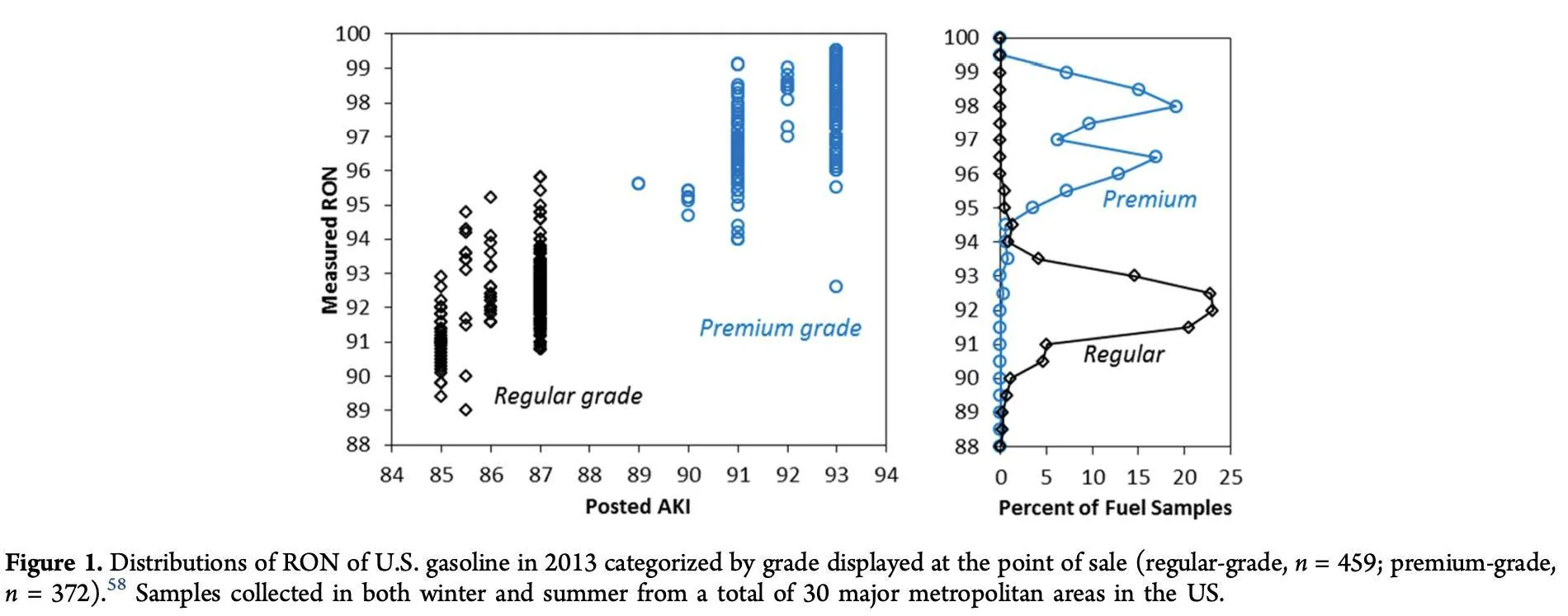
First learning: Octane Ratings and Ethanol Content of US Market

1: there is considerable variation in the fuel we actually get. The 87 Octane (AKI) may range from 91 to 96 (expected 91-92)
2. Fuel sales were 875 Regular (87 AKI), 3% Mid grade (91 AKI), 10% Premium (93 AKI).
3. Premium peaked in the 1980's at 30%.
4. Nearly all our gas is now 10% Ethanol (E10). Ethanol boosts the octane rating.
Ford Bronco Sport What MPG and Range can we expect on the Bronco Sport? Screen Shot 2024-10-23 at 4.50.05 PM


Ok, I’ll watch for data that’s proves your claim. Until then I’ll assume the difference isn’t enough to be relevant to the discussion.
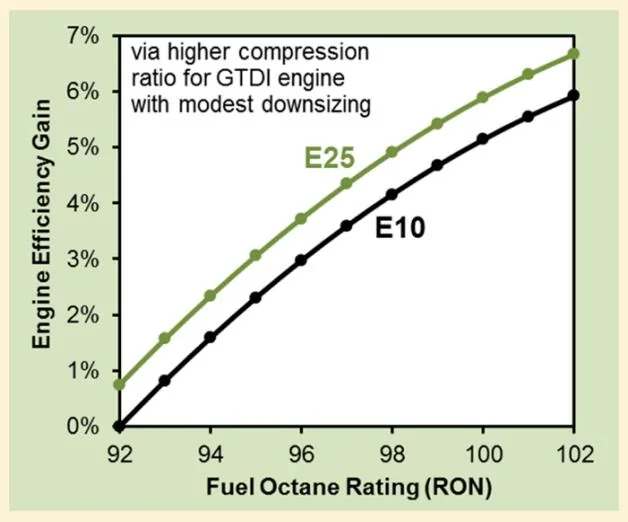
I found an intereting paper from 2015 by Ford, GM and FCA.

----
*The Effect of Compression Ratio, Fuel Octane Rating, and Ethanol Content on Spark-Ignition Engine Efficiency


OP
OP
NickAtNight

NickAtNight

Heritage
Well-Known Member
First Name
Nicholas James
Joined
Oct 8, 2024
Threads
4
Messages
86
Reaction score
50
Location
LaPlace La
Vehicle(s)
Bronco Sport Heritage 2023
Their paper claims a 4% increase in engine efficiency with Premium gas over Regular gas.

They obtain this improvement by shifting to higher engine compression.
E10 GasAKIRONEfficiency Gain
(R+M)/2R
Regular8791-92Baseline
Mid-Grade91963%
Premium93984%
Ford Bronco Sport What MPG and Range can we expect on the Bronco Sport? Screen Shot 2024-10-23 at 5.17.42 PM


87
Ok, I’ll watch for data that’s proves your claim. Until then I’ll assume the difference isn’t enough to be relevant to the discussion.
ABSTRACT: Light-duty vehicles (LDVs) in the United States and elsewhere are required to meet increasingly challenging regulations on fuel economy and greenhouse gas (GHG) emissions as well as criteria pollutant emissions.

New vehicle trends to improve efficiency include higher compression ratio, downsizing, turbocharging, downspeeding, and hybridization, each involving greater operation of spark-ignited (SI) engines under higher-load, knock-limited conditions. Higher octane ratings for regular-grade gasoline (with greater knock resistance) are an enabler for these technologies. This literature review discusses both fuel and engine factors affecting knock resistance and their contribution to higher engine efficiency and lower tailpipe CO2 emissions.

Increasing compression ratios for future SI engines would be the primary response to a significant increase in fuel octane ratings. Existing LDVs would see more advanced spark timing and more efficient combustion phasing.

Higher ethanol content is one available option for increasing the octane ratings of gasoline and would provide additional engine efficiency benefits for part and full load operation.

An empirical calculation method is provided that allows estimation of expected vehicle efficiency, volumetric fuel economy, and CO2 emission benefits for future LDVs through higher compression ratios for different assumptions on fuel properties and engine types.

Accurate “tank-to-wheel” estimates of this type are necessary for “well-to-wheel” analyses of increased gasoline octane ratings in the context of light duty vehicle transportation.


Mark S.

Badlands
Well-Known Member
First Name
Mark
Joined
Oct 30, 2021
Threads
119
Messages
6,733
Reaction score
13,154
Location
St. Jacob, IL
Vehicle(s)
2021 Badlands | 2020 Escape

Mark S.

Badlands
Well-Known Member
First Name
Mark
Joined
Oct 30, 2021
Threads
119
Messages
6,733
Reaction score
13,154
Location
St. Jacob, IL
Vehicle(s)
2021 Badlands | 2020 Escape
Their paper claims a 4% increase in engine efficiency with Premium gas over Regular gas.

They obtain this improvement by shifting to higher engine compression.
E10 GasAKIRONEfficiency Gain
(R+M)/2R
Regular8791-92Baseline
Mid-Grade91963%
Premium93984%
Ford Bronco Sport What MPG and Range can we expect on the Bronco Sport? Screen Shot 2024-10-23 at 5.17.42 PM


87
This makes sense: the increase in efficiency isn't coming from the higher octane, however, it's coming from the increase in compression ratio. Higher compression means the mixture is under higher pressure when it ignites which allows the mixture to more fully burn. The problem is we haven't figured out how to change internal combustion gasoline engine compression ratio on the fly just yet. We can, however, do something that effects the same result. By increasing boost pressure with a turbocharger you can force more air into the cylinder, which increases the pressure of the mixture prior to ignition. This is indeed one of the ways Ford extracts more power from their EcoBoost line of engines when burning premium. This only occurs, however, when the engine is under high power demand. That's why Ford says the most performance gains using premium fuel come under high power demand conditions such as towing, or under hot conditions. Why hot? Because increasing boost pressure (and cylinder pressures) adds heat. When you're burning regular gasoline you can generate enough heat to cause an uncontrolled ignition of the mixture after the spark fires--this is called detonation or knock. The powertrain control module (PCM) incorporates knock sensors that detect the first indication of detonation. When it does it reduces boost pressure and/or retards ignition timing to protect the engine. Premium requires greater heat and pressure to ignite, so even on hot days the PCM doesn't have to reduce boost or pull timing. That means more power on hot days.

I've never measured it myself, but most references online suggest highway cruising requires on the order of 50 hp--a little more for faster speeds, a little less for slower speeds. The engine is literally loafing along at that power demand. If anyone has a boost gauge they can check me on this, but I very much doubt the turbocharger is making any boost at all while cruising down the highway, and effective compression ratio remains constant unless you increase boost pressure.
 

Stircrazy

Outer Banks
Well-Known Member
First Name
Steve
Joined
Aug 25, 2024
Threads
9
Messages
382
Reaction score
482
Location
BC, Canada
Vehicle(s)
2023 Bronco sport
Before anyone roasts me I am not claiming to be smart or knowledgeable on this topic at all because I promise you I am not… HOWEVER, since switching to 93, I have gotten almost an extra 40-50 miles per tank calculated both by hand and by the odometer. (Difference by a mile or two between them) Driving patterns are exactly the same with no changes coming from my end. (that I’m aware of that is)

Also with all the discounts Shell gives me the extra money spent is negligible. Also, after speaking with multiple Ford mechanics they all recommended using high octane for the sake of the life of engine.

I did 3000km with 87 and 3000 with 94 and didnt see a difference at all. from everythign I have read if your not working the turbo or at higher rpm then the milage differance will be nill, where you see the benifit of premium is towing, higher speeds and driving with a heavy foot.
 

B-Dog15

Big Bend
Well-Known Member
First Name
Brandon
Joined
Nov 13, 2023
Threads
10
Messages
307
Reaction score
647
Location
Covington, Ky
Vehicle(s)
Bronco Sport
I did 3000km with 87 and 3000 with 94 and didnt see a difference at all. from everythign I have read if your not working the turbo or at higher rpm then the milage differance will be nill, where you see the benifit of premium is towing, higher speeds and driving with a heavy foot.
That makes sense. Idk what constitutes higher speeds but a good portion of my daily commute is highway which I drive between 75-80 mph?
 

Stircrazy

Outer Banks
Well-Known Member
First Name
Steve
Joined
Aug 25, 2024
Threads
9
Messages
382
Reaction score
482
Location
BC, Canada
Vehicle(s)
2023 Bronco sport
That makes sense. Idk what constitutes higher speeds but a good portion of my daily commute is highway which I drive between 75-80 mph?
ya my comute is 200km or 120ish miles every day at 75mph in the mountians and it didn't make a difference for me. I imagin if I was into the throttle passing people left and right it would make a difference but then my over all would be worse anyways. I just set the cruse and let it drive
Sponsored


Top