

Transmission oil life question...

sajohnson

Badlands
Well-Known Member
First Name
Sherman
Joined
Dec 1, 2021
Threads
29
Messages
1,826
Reaction score
1,880
Location
MIDDLETOWN, MD
Vehicle(s)
'22 Badlands ordered 12/17/2021 - Arrived 3/25/22
This is from the 2021 BS owners manual

Other Maintenance Items4​
Every 20,000 mi (32,000 km) Replace the cabin air filter.
Every 30,000 mi (48,000 km) Replace the engine air filter.
Every 100,000 mi (160,000 km) Replace the spark plugs.
Inspect the accessory drive belt(s).5
Every 150,000 mi (240,000 km) Change the automatic transmission fluid.
Replace the accessory drive belt(s).6
At 200,000 mi (322,000 km) Change the engine coolant.7

4Perform these maintenance items within 3,000 mi (4,800 km) of the last engine oil and filter change. Do not exceed the designated distance for the interval.
5After initial inspection, inspect every other oil change until replaced.
6If not replaced within the last 100,000 mi (160,000 km).
7Initial replacement at 10 years or 200,000 mi (322,000 km), then every five years or 100,000 mi (160,000 km).

If the vehicle is used in exreme conditions the the service interval are shorter

Towing a Trailer or Using a Car-top Carrier​
As required Change engine oil and filter as indicated by the information display and perform services listed in the Normal Scheduled Maintenance chart.
Inspect frequently, service as required Inspect rear axle and U-joints.
Every 30,000 mi (48,000 km) Change automatic transmission fluid.
Every 60,000 mi (96,000 km) Replace spark plugs.


Extensive Idling or Low-speed Driving for Long Distances, as in Heavy Commercial Use (Such as Delivery, Taxi, Patrol Car or Livery) Short Trips that do not allow the engine to get to operating temperature causing fuel dilution and an increase of the engine oil level​
As required Change engine oil and filter as indicated by the information display and perform services listed in the Normal Scheduled Maintenance chart.
Inspect frequently, service as required Replace cabin air filter.1
Replace engine air filter.
Every 30,000 mi (48,000 km) Change automatic transmission fluid.
Every 60,000 mi (96,000 km) Replace spark plugs.

1 This is an optional feature.

Operating in Dusty or Sandy Conditions (Such as Unpaved or Dusty Roads)​
Inspect frequently, service as required Replace cabin air filter.1
Replace engine air filter.
Every 5,000 mi (8,000 km) Inspect the wheels and related components for abnormal noise, wear, looseness or drag.
Rotate tires, inspect tires for wear and measure tread depth.
Every 5,000 mi (8,000 km) or six months Change engine oil and filter.
Perform multi-point inspection.
Every 30,000 mi (48,000 km) Change automatic transmission fluid.

1 This is an optional feature.

Exclusive Use of E85 (Flex Fuel Vehicles Only)​
Every oil change If ran exclusively on E85, fill the fuel tank full with regular unleaded fuel.
Damn! Using a car-top carrier (or trailer) really has an impact on the ATF service interval!

From 150,000 miles to 30K?

I can see how constantly towing a 2,000 lb.(+) trailer with a large frontal area would lower the recommended change interval, but a car-top carrier?

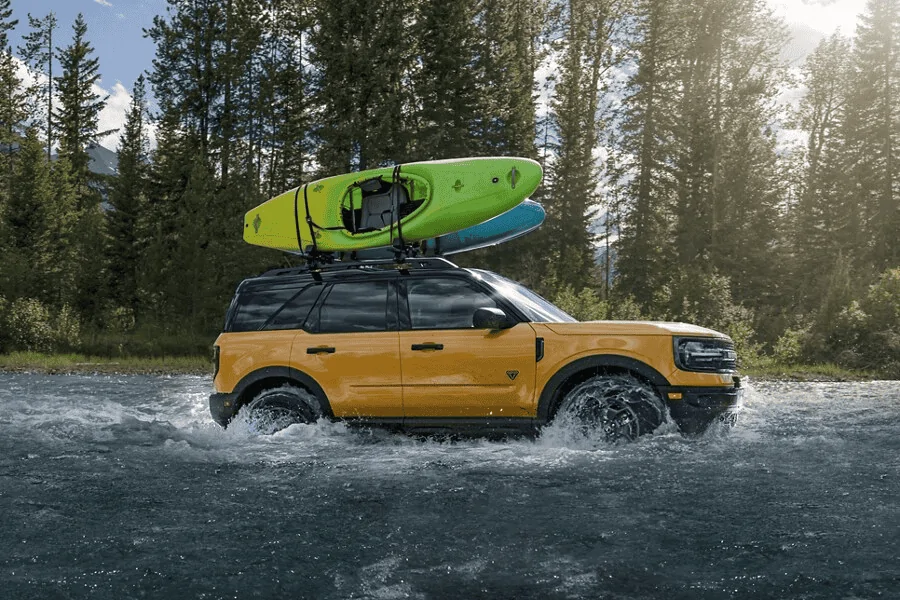
I suppose THIS would be a substantial additional wind load at highway speeds:
Ford Bronco Sport Transmission oil life question... 1697319202840
Sponsored


Mark S.

Badlands
Well-Known Member
First Name
Mark
Joined
Oct 30, 2021
Threads
119
Messages
6,733
Reaction score
13,152
Location
St. Jacob, IL
Vehicle(s)
2021 Badlands | 2020 Escape
Damn! Using a car-top carrier (or trailer) really has an impact on the ATF service interval!

From 150,000 miles to 30K?

I can see how constantly towing a 2,000 lb.(+) trailer with a large frontal area would lower the recommended change interval, but a car-top carrier?

I suppose THIS would be a substantial additional wind load at highway speeds:

Ford Bronco Sport Transmission oil life question... 1697319202840
Drag is a real.. well, drag. Drag has the greatest impact on highway fuel economy. Greater drag means greater power demand, and power demand equals heat.
 

Mark S.

Badlands
Well-Known Member
First Name
Mark
Joined
Oct 30, 2021
Threads
119
Messages
6,733
Reaction score
13,152
Location
St. Jacob, IL
Vehicle(s)
2021 Badlands | 2020 Escape
Are you serious? Your whole argument is a theory on how to improve operational readiness of a fleet (of British (unreliable) aircraft) under wartime conditions. Now you are saying your position has nothing to do with a fleet. If you want me to take you seriously, you need to take a serious position.
I don’t really care if you to take me seriously, but I would at least like you to read what I wrote. Yes, the data collected by Waddington came from a fleet of vehicles, but the conclusions drawn from the data apply to all of the vehicles in the fleet individually, and they can be applied to similar vehicles that do not operate as part of a fleet. It’s similar to data collected by the medical community on human health. The data come from a test group, but the conclusions drawn by the scientists who study the data generally applies to individuals whether or not they are part of the study group.

I agree with you, if Ford says that the oil/ fluid for the transmission, transfer case/ TPU, differentials can last 150,000 miles then the oil/ fluid can last for that long. I think I understand how Ford came to those conclusions.
Then what are we arguing about?

But, in real operations, those oils/ fluids do not last 150,000 miles if they are overloaded or contaminated. If overloading and/ or contamination happens your component will fail. Overloading is when the oil/ fluid heats up past its ability to do it’s job and breaks down. It is no longer an effective lubricant at that point.
Right, which is why Ford recommends periodic inspection and on condition replacement of the fluid if required.

Ford gives the consumer absolutely no way of knowing if they have overloaded their oil/ fluid. There is no temperature reading or gauge.
Yes it does. It publishes guidelines in the owner’s manual on the types of operations that require more frequent fluid replacement.

Ford doesn’t publish failure rates for any of these items but, the internet is full of people stuck with the cost of repairs due to failed items because they did not know they needed replace their oil/ fluid.
There are the odd posts from people who suffer early component failure. These are called anecdotes. If you believe there is a rash of component failures directly attributable to Ford’s fluid service interval then please share it.

Ford has given consumers fill and drain plugs on our vehicles. They didn’t do it for us though, they did it for actual fleet maintenance because generally, the same transmissions, transfer cases/ TPUs, and differentials are sold to state and cities in their emergency and service vehicles. These are vehicles that get driven hard, just like combat aircraft. These fleet managers were having problems because these components were failing early, well before 150,000 miles and there was no way for them to know when to do it or to do an actual service. If the vehicle was under warranty Ford paid for this. Ford fixed by adding a warning that told the driver/ fleet manager that the transmission and or other component had been overloaded and then fill and drain holes to change out the damaged oil/ fluid. Since these components are similar to ours we get them too minus the warnings. We can do the service, we just don’t know if we need to at 30,000 miles for example.
This sounds like you have some particular knowledge on the subject. Please share where it comes from, I’d be interested to read it.

Since we don’t know the component failure rate or if the oil/ fluid has been overloaded or contaminated, the only thing we can do is change the oil/ fluid at -30,000 miles.
Above you said “the internet is full of people with failed components because they didn’t know they needed to replace their fluid.” Now you’re saying we don’t know the failure rate, or even if the failures can be attributed to contaminated fluids. Which is it?

You can drive yours to 150,000 miles and then change your oils/ fluids. Good luck. You will be in the minority if you don’t have some sort of transmission, transfer case/ TPU, or differential problems at that point. I recommend you sell it to someone else so that they deal with the problems you caused. That’s a win for you.
Once again, the communication process has broken down. Please reread the many posts I’ve made on this subject. If inspection reveals my transmission fluid (or any other fluid for that matter) requires replacement then I’ll replace it. If not, I’ll avoid the possible complications accompanying unnecessary maintenance revealed by Waddington’s WWII study.


I’m glad that I only have one vehicle, that Ford isn’t British owned, that my vehicle isn’t in combat or providing a state or municipal service, that this is a modern vehicle, and that these components have fill and drain holes to do preventative maintenance to avoid know failures.

If you don’t understand these things there is nothing else to say to you.
Well okay then. I guess you’re done.
 

sajohnson

Badlands
Well-Known Member
First Name
Sherman
Joined
Dec 1, 2021
Threads
29
Messages
1,826
Reaction score
1,880
Location
MIDDLETOWN, MD
Vehicle(s)
'22 Badlands ordered 12/17/2021 - Arrived 3/25/22
Drag is a real.. well, drag. Drag has the greatest impact on highway fuel economy. Greater drag means greater power demand, and power demand equals heat.
Absolutely.

I'm not an engineer, but I have been working on and reading about cars for going on 50 years. I'm aware of Cd and the effect it has. That's why I wrote:

"I can see how constantly towing a 2,000 lb.(+) trailer with a large frontal area would lower the recommended change interval..."

I was not reacting to the fact that the ATF change interval is reduced, just the amount/degree of the reduction. From 150,000 miles down to 30K miles? 20% of the normal service interval is an extreme difference. I have never seen anything like that for "severe service".

I'm not disputing it. I'm not claiming it isn't necessary -- but it does imply that the transmission really isn't designed for any additional load beyond that of the BS itself.

Something else that caught my eye is that the manual equates a trailer with a car-top carrier. There is a lot of room there. Some car-top carriers are loaded as if the owner is going on a cross-county safari -- others are very aerodynamic (relatively speaking). Same with trailers. Some weigh 1 ton (or even more) and might have a large frontal area -- others are low and light, like our 400 lb. landscaping trailer.

With all of the sensors on modern vehicles, it's kind of surprising load and ATF temp is not measured. That would take all of the guesswork out of it.
 
Last edited:

Mark S.

Badlands
Well-Known Member
First Name
Mark
Joined
Oct 30, 2021
Threads
119
Messages
6,733
Reaction score
13,152
Location
St. Jacob, IL
Vehicle(s)
2021 Badlands | 2020 Escape
Absolutely.

I'm not an engineer, but I have been working on and reading about cars for going on 50 years. I'm aware of Cd and the effect it has. That's why I wrote:

"I can see how constantly towing a 2,000 lb.(+) trailer with a large frontal area would lower the recommended change interval..."

I was not reacting to the fact that the ATF change interval is reduced, just the amount/degree of the reduction. From 150,000 miles down to 30K miles? 20% of the normal service interval is an extreme difference. I have never seen anything like that for "severe service".

I'm not disputing it. I'm not claiming it isn't necessary -- but it does imply that the transmission really isn't designed for any additional load beyond that of the BS itself.

Something else that caught my eye is that the manual equates a trailer with a car-top carrier. There is a lot of room there. Some car-top carriers are loaded as if the owner is going on a cross-county safari -- others are very aerodynamic (relatively speaking). Same with trailers. Some weight 1 ton (or even more) and might have a large frontal area -- others are low and light, like our 400 lb. landscaping trailer.

With all of the sensors on modern vehicles, it's kind of surprising load and ATF temp is not measured. That would take all of the guesswork out of it.
I didn't think you were disputing, and I was agreeing with you. ?


Devil6

Badlands
Well-Known Member
First Name
R
Joined
Sep 23, 2023
Threads
0
Messages
48
Reaction score
16
Location
MSiuth West
Vehicle(s)
Yes
I don’t really care if you to take me seriously, but I would at least like you to read what I wrote. Yes, the data collected by Waddington came from a fleet of vehicles, but the conclusions drawn from the data apply to all of the vehicles in the fleet individually, and they can be applied to similar vehicles that do not operate as part of a fleet. It’s similar to data collected by the medical community on human health. The data come from a test group, but the conclusions drawn by the scientists who study the data generally applies to individuals whether or not they are part of the study group.


Then what are we arguing about?


Right, which is why Ford recommends periodic inspection and on condition replacement of the fluid if required.


Yes it does. It publishes guidelines in the owner’s manual on the types of operations that require more frequent fluid replacement.


There are the odd posts from people who suffer early component failure. These are called anecdotes. If you believe there is a rash of component failures directly attributable to Ford’s fluid service interval then please share it.


This sounds like you have some particular knowledge on the subject. Please share where it comes from, I’d be interested to read it.


Above you said “the internet is full of people with failed components because they didn’t know they needed to replace their fluid.” Now you’re saying we don’t know the failure rate, or even if the failures can be attributed to contaminated fluids. Which is it?


Once again, the communication process has broken down. Please reread the many posts I’ve made on this subject. If inspection reveals my transmission fluid (or any other fluid for that matter) requires replacement then I’ll replace it. If not, I’ll avoid the possible complications accompanying unnecessary maintenance revealed by Waddington’s WWII study.


Well okay then. I guess you’re done.
Do you work for or with Ford?

Please explain, if Ford gives you the failure rate by giving you conditions in which fluids must be replaced, how does one do an inspection to determine if the fluid needs to be replaced?
 

BigBadWolf

Big Bend
Well-Known Member
First Name
William
Joined
Mar 9, 2023
Threads
8
Messages
88
Reaction score
126
Location
Nashville Tennessee
Vehicle(s)
2023 Bronco Sport 2004 Mustang GT Convertible
Wife's 2004 Mustang GT is almost 20 years old with no end in site. Still looks new and drives new. It's at 95k right now. I guess we keep our vehicles longer than most. I'm sure my Bronco Sport will be around for a long time. That is if these Nashville TN (Nasholes) don't destroy it first.
 

Mark S.

Badlands
Well-Known Member
First Name
Mark
Joined
Oct 30, 2021
Threads
119
Messages
6,733
Reaction score
13,152
Location
St. Jacob, IL
Vehicle(s)
2021 Badlands | 2020 Escape
Do you work for or with Ford?

Please explain, if Ford gives you the failure rate by giving you conditions in which fluids must be replaced, how does one do an inspection to determine if the fluid needs to be replaced?
The Owner’s Manual recommends you have your vehicle’s fluids inspected by your dealership’s service department. Unless you have the tools and expertise you cannot do this yourself in your driveway or garage. You can certainly choose to replace the fluid as recommended if you regularly use the vehicle under the conditions specified, but if you prefer not to waste serviceable fluids you take the vehicle in to have them evaluated by a qualified technician.
 

Devil6

Badlands
Well-Known Member
First Name
R
Joined
Sep 23, 2023
Threads
0
Messages
48
Reaction score
16
Location
MSiuth West
Vehicle(s)
Yes
The Owner’s Manual recommends you have your vehicle’s fluids inspected by your dealership’s service department. Unless you have the tools and expertise you cannot do this yourself in your driveway or garage. You can certainly choose to replace the fluid as recommended if you regularly use the vehicle under the conditions specified, but if you prefer not to waste serviceable fluids you take the vehicle in to have them evaluated by a qualified technician.
Do you work for or with Ford?


Devil6

Badlands
Well-Known Member
First Name
R
Joined
Sep 23, 2023
Threads
0
Messages
48
Reaction score
16
Location
MSiuth West
Vehicle(s)
Yes
No, but I did stay at a Holiday Inn Express last night. :crackup:
Ok, great.

Would it be possible to unknowingly meet Ford’s requirements for oil/ fluid replacement without using the vehicle in a way Ford says requires replacement?
 

Mark S.

Badlands
Well-Known Member
First Name
Mark
Joined
Oct 30, 2021
Threads
119
Messages
6,733
Reaction score
13,152
Location
St. Jacob, IL
Vehicle(s)
2021 Badlands | 2020 Escape
Ok, great.

Would it be possible to unknowingly meet Ford’s requirements for oil/ fluid replacement without using the vehicle in a way Ford says requires replacement?
Yes, which is why you should have your fluids inspected periodically as recommended.
 

Devil6

Badlands
Well-Known Member
First Name
R
Joined
Sep 23, 2023
Threads
0
Messages
48
Reaction score
16
Location
MSiuth West
Vehicle(s)
Yes
Yes, which is why you should have your fluids inspected periodically as recommended.
Ok.

Would it be possible for Ford to under fill a transmission, transfer case, PTU, or differential?


Top